Salers Cattle Breed Guide: Rustic French Breed Profile
A complete guide to Salers cattle for professional buyers — covering the breed's origins in volcanic Auvergne, mahogany coat, lyre-shaped horns, crossbreeding value, mountain adaptation, and French sourcing profiles.
Table of Contents
Introduction to Salers Cattle
The Salers is one of France's oldest and most distinctive cattle breeds, immediately recognizable by its rich dark mahogany coat and elegant lyre-shaped horns. Originating from the volcanic highlands of the Cantal department in the Auvergne region of south-central France, the Salers has been shaped by centuries of adaptation to some of the most demanding mountain terrain in Europe. The result is a breed of exceptional hardiness, strong maternal instincts, and versatile production capabilities.
For professional livestock buyers — particularly those seeking cattle for crossbreeding programs, rugged-terrain operations, or diversified fattening portfolios — the Salers offers a compelling combination of rustic constitution and commercial productivity. While less widely traded internationally than France's dominant export breeds (Charolais and Limousin), the Salers has a dedicated following among buyers who value its unique attributes and the specific sourcing profiles available from France's Massif Central region.
This guide provides a comprehensive overview of the Salers breed for livestock procurement professionals — covering its mountain origins, physical characteristics, production performance, crossbreeding applications, sourcing from France, and the practical considerations for integrating Salers cattle into commercial fattening and breeding programs.
Breed Origin and Heritage
The Salers breed takes its name from the medieval town of Salers in the Cantal department of the Auvergne-Rhone-Alpes region of France. This area — part of the Massif Central, the vast volcanic plateau that dominates south-central France — is characterized by high-altitude pastures (estives), steep terrain, harsh winters, and a short but productive summer grazing season. It was in this unforgiving environment that the Salers breed evolved over thousands of years.
Archaeological and historical evidence suggests that cattle of Salers type have inhabited the Cantal region since at least the Gallo-Roman period. Cave paintings in the Auvergne depict cattle remarkably similar to the modern Salers, suggesting a lineage extending back 7,000-10,000 years. This extraordinary antiquity makes the Salers one of the oldest identifiable cattle breeds in the world.
Historically, Salers cattle were true multi-purpose animals. During the summer months, herds were driven to high-altitude pastures (transhumance) where they grazed volcanic grasslands at elevations of 1,000-1,500 meters. The cows were milked to produce Cantal and Salers cheeses — both now protected appellation d'origine products with centuries of tradition. In winter, the cattle returned to valley farms where they provided draft power and eventually meat.
The first Salers herd book was established in 1853, making it one of the earliest formally documented cattle breeds in France. Throughout the 20th century, the breed underwent a gradual transition from triple-purpose (draft, dairy, and beef) to primarily beef and maternal use, though a small population of milking Salers herds is still maintained for traditional cheese production.
Today, the French Salers population numbers approximately 210,000 cows, concentrated in the Cantal, Puy-de-Dome, and surrounding departments of the Massif Central. The breed has also been exported to numerous countries including the United States, Canada, the United Kingdom, Australia, and several South American nations.
Physical Characteristics and Appearance
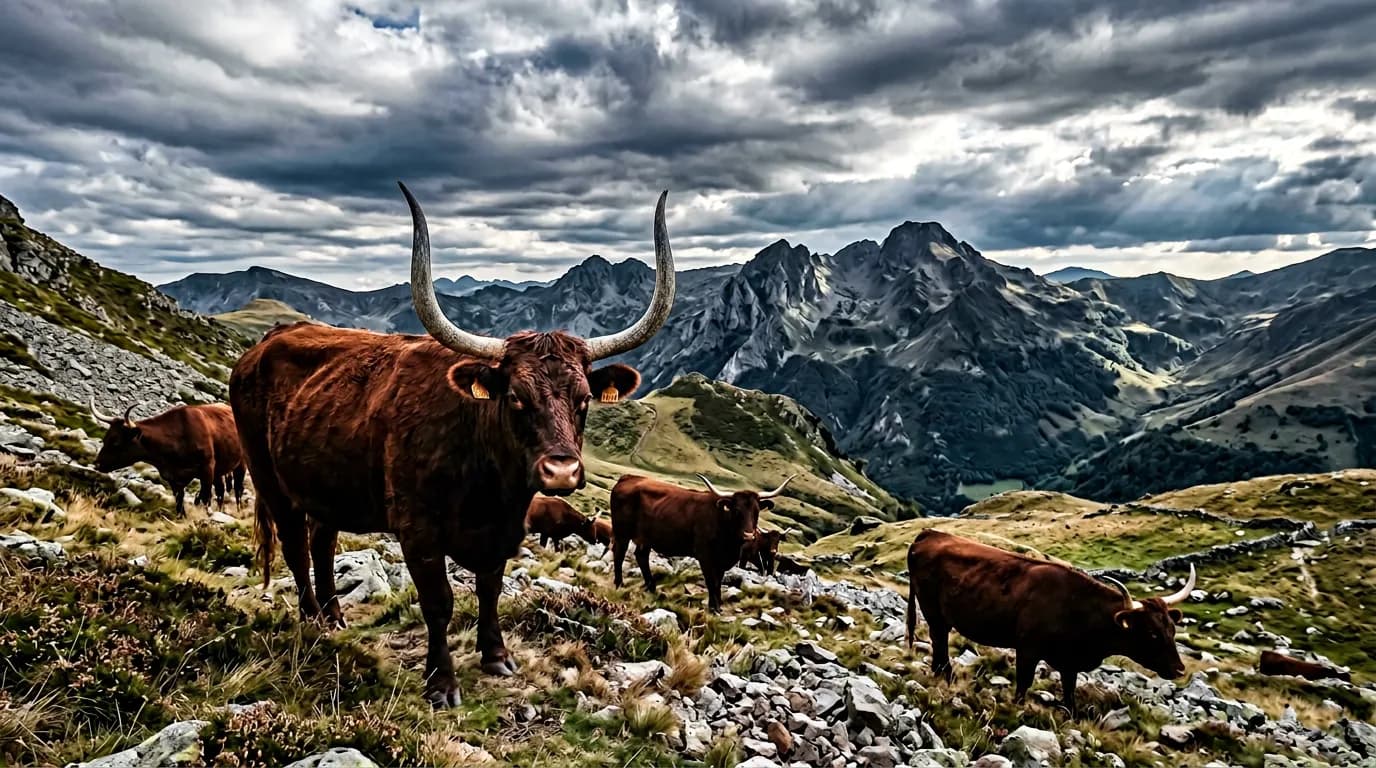
The Salers is one of the most visually striking cattle breeds in Europe, with a physical appearance that reflects its mountain heritage and ancient lineage. The breed's most immediately recognizable features are its deep, rich mahogany-red coat and its long, elegant, lyre-shaped horns that sweep outward and upward from the head in a distinctive crescent pattern.
The coat color ranges from dark mahogany to cherry red, and the hair is typically longer and thicker than most beef breeds — particularly in winter, when a dense, curly coat develops that provides insulation against the harsh mountain climate. The skin beneath is heavily pigmented, providing excellent protection against ultraviolet radiation at high altitudes. A small number of 'black Salers' exist, carrying a recessive gene for black coat color, but the mahogany phenotype defines the breed standard.
The lyre-shaped horns are a signature breed characteristic. They grow outward and upward from the head, curving forward slightly at the tips, creating an elegant silhouette that has made the Salers an iconic image of the Auvergne landscape. While polled (hornless) Salers lines have been developed to meet modern management preferences, the horned type remains the traditional and most common form.
In terms of body conformation, the Salers is a large-framed breed with substantial bone structure. Mature cows typically weigh 650-800 kg, while bulls range from 1,000-1,200 kg. The breed displays a long body with good depth, strong legs with excellent hoof quality, a well-developed chest, and moderate muscling through the hindquarter. The overall conformation reflects the breed's dual heritage as both a working and producing animal — strong, functional, and built for longevity rather than extreme muscular development.
The Salers' physical structure is ideally adapted to mountainous terrain. The breed has notably strong legs and hard, well-formed hooves that enable sure-footed movement on rocky slopes and uneven ground. The long stride and efficient locomotion of the Salers allow it to cover large distances on mountain pastures — a critical adaptation for breeds that historically depended on transhumance grazing systems.
Hardiness and Mountain Adaptation
The Salers' hardiness is not an abstract quality but a measurable set of biological adaptations refined over thousands of years of natural and artificial selection in one of Europe's most challenging cattle-raising environments. Understanding these adaptations helps explain the breed's value in modern production systems, particularly in operations where environmental resilience translates directly into reduced management costs and improved survival rates.
Climatic resilience is perhaps the most notable aspect of Salers hardiness. The breed's thick, curly winter coat provides effective insulation against cold, wind, and precipitation. Summer coat shedding is efficient, enabling heat dissipation during warm months. The heavily pigmented skin protects against solar radiation — an important adaptation at the high altitudes of the Massif Central, where UV exposure is intensified. This combination of coat and skin characteristics enables Salers cattle to maintain body condition and productivity across a wide range of temperatures and weather conditions.
Foraging ability and nutritional efficiency are equally important aspects of the breed's hardiness. Salers cattle are aggressive and selective foragers that actively seek out diverse plant species on rough terrain. They maintain body condition on lower-quality forages that would challenge more production-intensive breeds. This forage efficiency stems from a highly developed rumen microbiome adapted to the diverse botanical composition of mountain pastures.
Disease resistance in Salers cattle is enhanced by the breed's natural vigor and strong immune function. Salers herds in their native environment historically experienced low rates of common cattle diseases, and the breed maintains good general health with minimal veterinary intervention. Foot and leg problems — a common issue in many breeds housed on concrete — are notably rare in Salers due to the breed's excellent hoof structure.
Calving ease is a significant and often underappreciated aspect of Salers hardiness. Despite producing vigorous, well-sized calves, Salers cows have remarkably low rates of calving difficulty. Unassisted calving rates in Salers herds typically exceed 95%, reflecting the breed's well-proportioned pelvic structure and strong maternal instincts. Calves are born alert and stand quickly, nursing within minutes of birth — essential traits for survival in mountain environments.
For livestock buyers, the practical implications of Salers hardiness include lower mortality and morbidity during transport, faster adaptation to new environments, reduced veterinary costs during fattening, and the ability to perform in management systems ranging from extensive to semi-intensive.
Production Performance and Beef Quality
While the Salers is not typically classified among the top beef breeds for raw growth rate, its production performance is highly competitive when evaluated in the context of total system efficiency — accounting for maternal productivity, forage utilization, longevity, and carcass value rather than growth rate alone.
Growth performance for Salers cattle in finishing systems typically ranges from 1.0-1.3 kg average daily gain, with feed conversion ratios of 6.5:1 to 8:1 depending on the diet and management system. These figures place the Salers in the moderate-performance category compared to the most intensive beef breeds, but they are achieved with lower feed costs and management inputs, particularly when forage-based finishing is employed.
Carcass characteristics of finished Salers cattle are commercially respectable. Dressing percentages typically range from 56-60%, with EU conformation grades of R to U for well-finished animals. The meat is characterized by good color, fine grain texture, and moderate but consistent marbling that contributes to eating quality. Fat cover is adequate for good carcass presentation without the excess that some lighter-framed breeds may deposit.
The Salers breed has received positive attention for the distinctive flavor profile of its beef. The volcanic mineral-rich soils of the breed's native Auvergne region are said to contribute to a distinctive taste in the meat of pasture-raised Salers — a concept related to the French notion of 'terroir' applied to livestock production. While this association is strongest for animals raised on Auvergne pastures, the breed's general beef quality characteristics are maintained in other finishing environments.
Maternal productivity is where the Salers breed particularly excels. Salers cows are known for high milk production relative to other beef breeds — sufficient to support strong calf growth — combined with excellent calving ease, protective maternal behavior, and outstanding longevity. Productive lifespans of 12-15 years are common, significantly exceeding most beef breeds. This longevity reduces replacement costs and improves lifetime productivity per cow.
For Italian fattening operations, Salers cattle are most commonly encountered as part of crossbreeding programs rather than as purebred finishing animals. The breed's maternal and hardiness traits are frequently combined with terminal sire breeds to produce crossbred calves with improved finishing performance.
Crossbreeding Programs and Terminal Sire Use
The Salers' greatest commercial impact in the broader European beef industry comes through its role in crossbreeding programs. The breed's combination of calving ease, maternal milk production, hardiness, and longevity makes it an outstanding dam breed, while its moderate frame and good muscling contribute positively to crossbred progeny performance.
The most common crossbreeding application uses Salers cows as the maternal base, mated to terminal sire breeds — particularly Charolais, Limousin, and Blonde d'Aquitaine. This cross exploits heterosis (hybrid vigor) and combines the Salers cow's calving ease and maternal ability with the superior muscling and growth rate of the terminal sire breed. The resulting calves (F1 crosses) display enhanced growth performance, improved carcass conformation, and the vigor associated with crossbreeding.
Salers x Charolais is the most widely practiced cross in France. The Salers dam contributes calving ease (reducing the dystocia risk associated with pure Charolais breeding), abundant milk for calf growth, and hardy constitution. The Charolais sire contributes heavy muscling, rapid growth, and premium carcass value. The resulting crossbred broutards are well-regarded in Italian fattening markets for their balanced performance characteristics.
Salers x Limousin crosses produce calves with exceptional meat-to-bone ratio combined with Salers-derived hardiness and maternal traits. These crosses are particularly valued for their consistent carcass quality and the relatively fine bone structure inherited from the Limousin parent.
For Italian buyers sourcing from France, Salers-cross cattle represent a specific procurement category with distinct characteristics. Salers-cross broutards are typically available in the same seasonal windows as other French beef-breed products (primarily September-December) and are sourced from the Massif Central region — often from farms that also produce purebred Charolais or Limousin cattle using Salers maternal stock.
The identification of Salers influence in crossbred cattle is straightforward — the breed's dark red coloring and characteristic horn type are partially dominant, so F1 crosses typically display a reddish coat color and, in horned populations, the lyre-shaped horn tendency. This visual identification helps buyers verify breed composition in commercial lots.
Sourcing Salers Cattle from France
Sourcing Salers and Salers-cross cattle from France requires understanding the specific geographic and market dynamics of the breed's production system. Unlike Charolais, which are broadly distributed across central France, Salers production is concentrated in a defined region centered on the Massif Central — primarily the departments of Cantal, Puy-de-Dome, Haute-Loire, Aveyron, and Correze.
The production system in the Salers heartland is predominantly grass-based, with extensive use of summer mountain pastures (estives) and winter housing with conserved forage. This system produces animals with distinct characteristics — well-grown on natural pastures, accustomed to outdoor conditions, and with robust constitutions shaped by the mountain environment. The seasonal nature of this production system means that calf availability follows predictable patterns, with the main marketing period for weaned calves occurring in autumn (September-November).
Purebred Salers broutards are available for purchase, typically weighing 300-420 kg at 8-12 months of age. These animals are suited to longer fattening programs where their forage efficiency and hardiness can be fully utilized. However, the volume of purebred Salers broutards in export channels is relatively modest compared to Charolais or Limousin — reflecting the breed's smaller total population and the tendency for many Salers producers to retain females for breeding.
Salers-cross broutards — particularly Salers x Charolais and Salers x Limousin — are available in larger volumes and represent the primary Salers-related procurement category for Italian buyers. These crosses are typically marketed through the same channels as other French beef-breed products: livestock markets, direct farm purchases, and organized collection programs.
Key livestock markets for Salers and Salers-cross cattle include Mauriac and Aurillac in the Cantal department, and regional markets throughout the northern Massif Central. Bovatra maintains sourcing relationships in these areas, enabling procurement of both purebred and crossbred Salers cattle to match specific buyer requirements.
Pricing for Salers and Salers-cross cattle typically reflects a modest discount to equivalent-weight purebred Charolais or Limousin animals, making them an economically attractive option for buyers seeking hardy, well-adapted cattle at competitive prices.
Transport and Adaptation Considerations
Transporting Salers cattle from the Massif Central to Italian fattening operations involves standard EU cross-border livestock transport requirements, with some breed-specific considerations that can influence transport outcomes and post-arrival adaptation.
The typical transport route from the Salers-producing regions of central France to northern Italy covers 900-1,300 km depending on specific origin and destination points. Journey times of 14-22 hours are standard, generally within the EU regulation limits for cattle transport. The route typically crosses the Alps via the Frejus or Mont Blanc tunnels or the Riviera coastal route, depending on the transport operator's preference and seasonal conditions.
Salers cattle generally transport well, benefiting from their inherent hardiness and calm constitution. The breed's thick coat and strong constitution provide resilience against the stress of transport, and their foraging adaptability means they readily consume feed and water during rest stops. Transport mortality and morbidity rates for Salers cattle are typically low — a direct benefit of the breed's robust constitution.
However, one breed-specific consideration deserves attention: the Salers' lyre-shaped horns. In horned populations, the long, outward-sweeping horns require adequate space during transport and can pose injury risks to pen mates in confined conditions. Transport vehicles should be configured with appropriate space allowances, and mixing horned Salers with smaller or polled breed types should be avoided. Many transport operators are experienced in managing horned cattle from the Massif Central region and adjust loading practices accordingly.
Post-arrival adaptation for Salers cattle moving from mountain pasture environments to Italian fattening facilities requires attention to dietary transition. Animals accustomed to diverse mountain pastures may need a longer step-up period when transitioning to high-energy finishing rations. A 3-4 week adaptation program that gradually introduces concentrates while maintaining adequate forage access is recommended.
Housing adaptation is also relevant. Salers cattle raised in extensive outdoor systems may initially be stressed by confinement in housed fattening facilities. Where possible, providing outdoor access or larger pen spaces during the initial adaptation period can reduce stress and accelerate the transition to normal feeding behavior.
All standard EU documentation requirements apply to Salers cattle transport, including TRACES notification, health certificates, transport authorization, and journey logs. Bovatra coordinates the complete documentation and logistics chain for all shipments from the Massif Central to Italian destinations.
Specific Sourcing Profiles for Italian Buyers
Italian fattening operators seeking to incorporate Salers genetics into their programs can choose from several distinct sourcing profiles, each suited to different operational models and market objectives.
The first profile is purebred Salers store cattle for extended finishing. These are typically 8-12 month old animals weighing 300-420 kg, sourced directly from Salers breeding farms in the Cantal and surrounding departments. They are best suited to operations that can accommodate a longer finishing period (5-8 months) and benefit from the breed's forage efficiency. The market for finished purebred Salers targets quality-conscious buyers who value the breed's distinctive beef characteristics.
The second profile is Salers-cross broutards for standard finishing. These are typically F1 crosses of Salers dams with Charolais, Limousin, or Blonde d'Aquitaine sires, aged 8-12 months and weighing 350-480 kg. This is the most commercially relevant category for Italian fattening operations, offering a balance of Salers-derived hardiness with improved muscling and growth potential from the terminal sire. Finishing periods of 4-6 months are standard, with target slaughter weights of 600-720 kg.
The third profile is Salers breeding stock for maternal herd development. Professional breeding operations seeking to establish or expand Salers or Salers-cross maternal herds can source heifers and young cows from established French herds. This is a specialist procurement category requiring careful genetic selection and longer-term planning but offers significant returns through the breed's maternal productivity and longevity.
The fourth profile involves older Salers-cross store cattle, typically 12-18 months old and weighing 450-550 kg, suitable for shorter finishing programs. These animals have typically been grown on grass-based systems in France and require only 3-4 months of intensive finishing to reach market readiness.
Bovatra can advise on which sourcing profile best matches a buyer's operational capabilities, facility specifications, and market objectives. Our knowledge of the Massif Central production system and established relationships with Salers producers enable efficient procurement across all categories.
For buyers new to Salers genetics, we recommend starting with Salers-cross broutards (Profile 2) as an introduction to the breed type, allowing operators to evaluate performance and adaptation characteristics before potentially expanding into purebred or breeding stock procurement.
Why Consider Salers for Your Procurement Strategy
The Salers breed occupies a distinctive niche in European beef production — one defined by exceptional hardiness, strong maternal traits, versatile crossbreeding applications, and a heritage rooted in one of France's most celebrated agricultural landscapes. For professional livestock buyers, these characteristics translate into specific commercial advantages that deserve consideration in procurement planning.
The economic argument for Salers and Salers-cross cattle centers on the favorable balance between purchase cost and finishing performance. Salers-related cattle are typically available at a modest discount to premium Charolais or Limousin pricing, yet they deliver competitive finishing results — particularly in systems that incorporate significant forage components. The breed's hardiness reduces losses during transport and adaptation, improving the effective cost per surviving head placed on feed.
For operations that manage their own breeding herds as a source of fattening stock, Salers genetics offer transformative maternal advantages. The breed's calving ease (greater than 95% unassisted births), milk production, longevity, and low maintenance requirements can dramatically reduce the cost of calf production while maintaining a consistent supply of quality feeder cattle — particularly when Salers cows are mated to terminal beef sires.
The crossbreeding flexibility of the Salers breed is a key strategic advantage. Rather than committing entirely to one breed type, buyers can use Salers as a complementary element in a multi-breed procurement approach — sourcing Salers-cross broutards alongside purebred Continental breeds to balance quality, cost, and supply diversity.
From a sustainability perspective, the Salers breed aligns well with growing market interest in extensive, grass-based, and environmentally responsible beef production. The breed's ability to thrive on natural mountain pastures with minimal inputs supports production narratives that resonate with increasingly conscious consumers and retailers.
Bovatra is committed to helping professional buyers access the full range of French beef genetics, including specialist breeds like the Salers. Our presence in the Massif Central sourcing region and our understanding of the breed's specific procurement dynamics enable us to deliver Salers and Salers-cross cattle that meet exacting buyer specifications. Contact us to explore how Salers genetics can strengthen your livestock procurement portfolio.
Source Salers Cattle
Related Guides
Aubrac Cattle Breed Guide: Resilient French Breed for Fattening
A comprehensive guide to Aubrac cattle for professional buyers — covering breed characteristics, resilience, fattening performance, sourcing from France, and cross-border logistics to Italy.
Buying Cattle From France: Breeds, Markets & Export Process
A comprehensive guide to sourcing cattle from France for European buyers — covering available breeds, livestock markets, seasonal patterns, export documentation, and transport logistics.
Charolais Cattle Breed Guide: Characteristics, Feeding & Sourcing
Everything professional buyers need to know about Charolais cattle — from breed characteristics and growth performance to sourcing from France and transport to Italy.
Ready to Source Livestock — or List Your Stock?
Whether you are a buyer looking for specific breeds or a seller seeking reliable access to European buyers, Bovatra manages the full transaction cycle.