
Charolais Cattle Breed Guide: Characteristics, Feeding & Sourcing
Everything professional buyers need to know about Charolais cattle — from breed characteristics and growth performance to sourcing from France and transport to Italy.
Table of Contents
Introduction to Charolais Cattle
The Charolais is one of the most recognizable and commercially significant beef cattle breeds in the world. Originating from the Charolles region of Burgundy in east-central France, this breed has earned its reputation through centuries of selective breeding focused on muscular development, growth efficiency, and carcass quality. Today, Charolais cattle are found on every continent and remain one of the most traded breeds in European livestock markets.
For professional livestock buyers — particularly those operating fattening operations in Italy's Po Valley, Veneto, Lombardy, and Piedmont regions — Charolais cattle represent a cornerstone of procurement strategy. Their exceptional growth rates, feed conversion efficiency, and high carcass yield make them ideally suited to intensive and semi-intensive finishing systems. Understanding the breed's characteristics, management requirements, and sourcing dynamics is essential for any serious buyer in the European cattle trade.
This guide covers everything you need to know about Charolais cattle: from their physical traits and performance data to feeding strategies, health considerations, sourcing from France, and the logistics of EU-compliant transport to Italy.
Breed Origin and History
Charolais cattle trace their lineage to the white cattle of the Charolles district in the Saône-et-Loire department of France. Historical records mention white cattle in this region as early as 878 AD, though the modern breed was formalized through organized breeding programs beginning in the 18th century. The first herd book was established in 1842, making it one of the oldest documented beef breeds in Europe.
The breed's development was driven by French farmers who prioritized muscular development and working capacity — Charolais were originally draft animals as well as beef producers. This dual heritage contributed to the breed's characteristic heavy muscling and strong skeletal structure. By the mid-20th century, Charolais had been exported globally, arriving in North America in the 1930s and becoming one of the dominant beef breeds worldwide by the 1970s.
In the context of European livestock trade, France remains the primary source of purebred and commercial Charolais cattle. The Nivernais, Bourbonnais, and Charolles regions in central France concentrate the highest density of Charolais herds, with an estimated national population exceeding 1.8 million head. This deep breeding base ensures consistent availability for cross-border procurement programs.
Physical Characteristics and Conformation
Charolais cattle are immediately recognizable by their white to creamy-white coat, which is medium to thick in texture. The breed displays a distinctly muscular conformation with broad shoulders, a wide back, and heavily muscled hindquarters. Mature bulls typically weigh between 1,000 and 1,300 kg, while cows range from 700 to 900 kg — making Charolais one of the heaviest beef breeds in commercial production.
Key physical traits that define the breed include a relatively small head in proportion to body size, short and powerful neck, deep chest, and well-sprung ribs. The breed is naturally horned, though polled lines have been developed in some countries. Skin pigmentation is light, and the muzzle is typically pale pink.
From a buyer's perspective, the most commercially relevant physical characteristics are the breed's exceptional muscular development and length of body. These traits translate directly into high carcass yield — typically 60-65% dressing percentage — which is among the highest of any beef breed. The meat is characteristically lean with relatively low intramuscular fat, making it well-suited to markets that prioritize lean beef, including Italy's traditional veal and young beef sectors.
When evaluating Charolais cattle for purchase, experienced buyers look for balanced conformation, structural soundness in the legs and feet, adequate depth of body, and evidence of good muscling through the loin and hindquarter. Animals with narrow chests, weak toplines, or excessive coarseness should be avoided, as these traits often correlate with poor finishing performance.
Growth Performance and Feed Efficiency
Charolais cattle are renowned for their growth performance, which is among the highest of all European beef breeds. Under typical European finishing conditions, Charolais steers and young bulls routinely achieve average daily gains (ADG) of 1.3 to 1.6 kg per day, with exceptional animals reaching 1.8 kg per day or more in well-managed intensive systems.
Feed conversion ratios (FCR) for Charolais cattle typically range from 5.5:1 to 7:1 (kg feed per kg gain), depending on the feeding system, diet composition, and age at finishing. This efficiency is competitive with any breed and is one of the primary reasons Italian fattening operators prefer Charolais for their operations.
In Italian fattening systems, Charolais broutards (young weaned calves, typically 8-12 months old and weighing 350-450 kg) are commonly purchased from France and finished to slaughter weights of 650-750 kg over a 4-6 month finishing period. This weight gain trajectory aligns well with Italian market requirements for young beef (vitellone) production.
Key performance benchmarks for Charolais cattle in Italian finishing systems include birth weight of 40-48 kg for calves, weaning weight of 280-350 kg at 7-8 months, finishing weight of 650-750 kg at 14-18 months, and carcass weight of 380-480 kg. These figures represent typical commercial performance rather than exceptional individual results, making them reliable planning parameters for procurement decisions.
Feeding and Nutrition Strategies
Successful finishing of Charolais cattle requires a feeding program that supports their high growth potential while maintaining feed efficiency and carcass quality. In Italian fattening operations, Charolais are typically fed a total mixed ration (TMR) based on maize silage, cereal grains, protein supplements, and mineral-vitamin premixes.
A typical finishing ration for Charolais cattle in Italian feedlots consists of approximately 40-50% maize silage, 25-35% concentrate mix (barley, maize grain, wheat), 10-15% protein source (soybean meal, rapeseed meal), and 3-5% mineral and vitamin supplements. The target dry matter intake for finishing Charolais is typically 2.2-2.5% of body weight per day.
During the initial adaptation period after arrival from France — usually the first 2-3 weeks — it is critical to transition animals gradually from a forage-based diet to the higher-energy finishing ration. Abrupt dietary changes can trigger acidosis, respiratory stress, and reduced intake. A step-up program that incrementally increases concentrate levels over 14-21 days is standard practice.
Water intake is equally important and often underestimated. Charolais cattle in finishing systems require 40-70 liters of clean water per day depending on body weight, ambient temperature, and diet dry matter content. Inadequate water access directly reduces feed intake and growth performance.
Protein levels in the finishing ration should be maintained at 12-14% crude protein on a dry matter basis for growing animals, with adjustments based on age and target growth rate. Energy density typically targets 11-12 MJ metabolizable energy per kg of dry matter for the finishing phase.
Health Considerations for Buyers
Charolais cattle are generally robust and well-adapted to European climatic conditions. However, several health considerations are particularly relevant for buyers importing animals across EU borders.
Respiratory disease is the most significant health challenge for Charolais cattle during and immediately after transport. The stress of loading, transit, unloading, and adaptation to a new environment — collectively known as 'shipping fever' — can trigger bovine respiratory disease (BRD) complex. Buyers should ensure that sourced animals have been properly vaccinated against major respiratory pathogens (IBR, BVD, PI3, BRSV) at least 2-3 weeks before transport.
Calving difficulty (dystocia) is a well-known characteristic of the Charolais breed due to the high birth weights of calves. While this is primarily a concern for breeding operations, buyers of pregnant females should be aware of the breed's higher-than-average calving assistance rates. For fattening operations purchasing young bulls or steers, this is not a relevant concern.
Parasitic infections, particularly gastrointestinal worms and liver fluke, should be assessed and treated before transport. French Charolais raised on pasture may carry significant parasite burdens that can impair performance during the finishing phase if left untreated.
All animals imported to Italy must meet EU health certification requirements, including testing for tuberculosis, brucellosis, and leukosis. Bovatra manages the complete veterinary documentation process as part of every transaction, ensuring that health compliance is handled without gaps or delays.
Sourcing Charolais from France
France is overwhelmingly the primary source of Charolais cattle for Italian buyers. The breed's heartland — the Nivernais, Bourbonnais, and Charolles regions — offers the deepest selection of quality animals, with thousands of farms specializing in Charolais production.
The French Charolais market operates on seasonal patterns that experienced buyers plan around. The primary marketing season for broutards runs from September through December, when spring-born calves reach weaning age and weight. A secondary peak occurs in March through May for autumn-born animals. Prices typically peak during periods of high demand from Italian buyers, particularly in October-November.
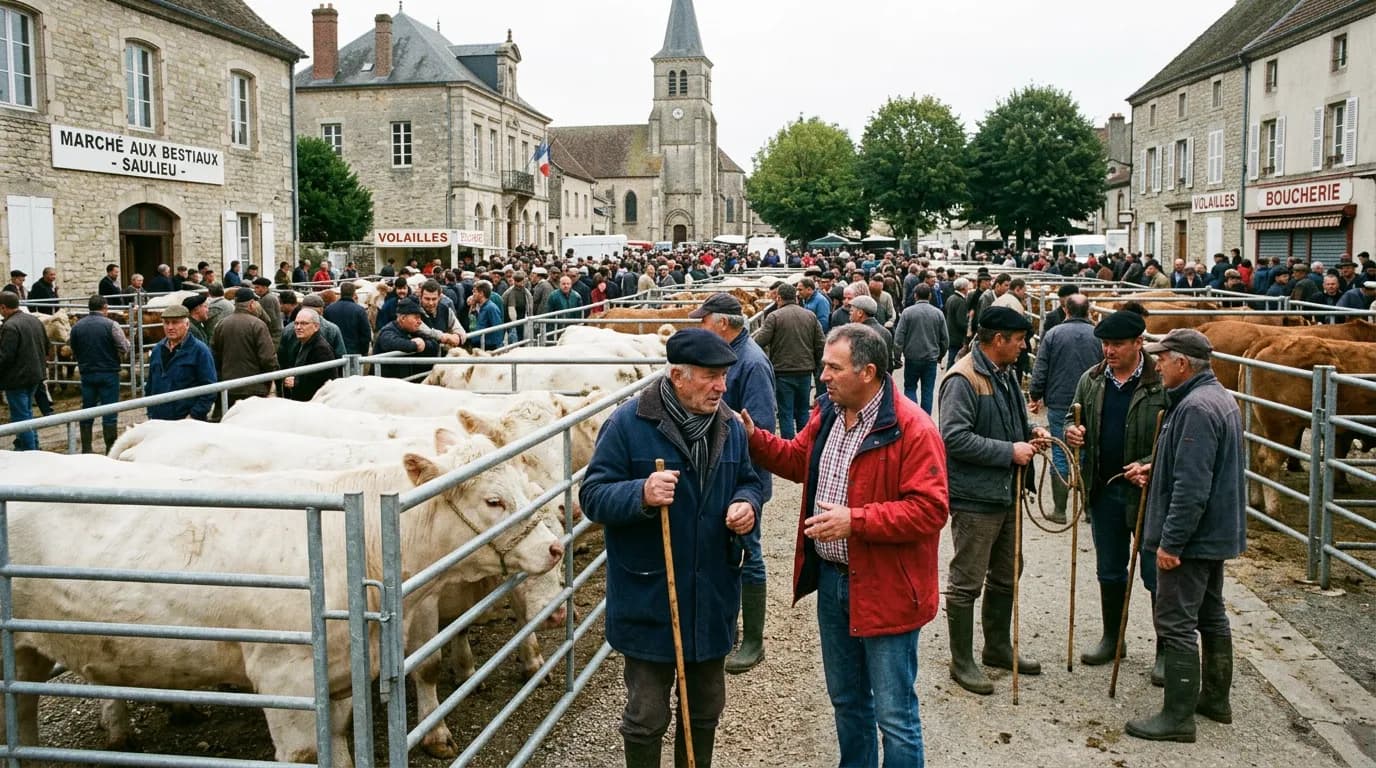
Purchasing channels in France include direct farm purchases, livestock markets (marchés aux bestiaux), and broker networks. Each channel has advantages and trade-offs in terms of selection quality, price transparency, and logistical efficiency. Major livestock markets at Saint-Christophe-en-Brionnais, Moulins, and Charolles handle significant volumes of Charolais cattle and provide a centralized purchasing environment.
Typical purchase specifications for Italian fattening operations include broutard bulls aged 8-12 months weighing 350-450 kg, young store cattle aged 12-18 months weighing 450-550 kg, and finished young bulls weighing 600-750 kg for direct slaughter channels. Bovatra sources across all these categories, matching buyer specifications to available supply across our French network.
Transport and Logistics to Italy
Transporting Charolais cattle from France to Italy requires careful planning to ensure animal welfare, regulatory compliance, and timely delivery. All livestock transport within the EU must comply with Council Regulation (EC) No 1/2005, which sets strict requirements for journey times, rest periods, vehicle standards, and animal care during transit.
The typical transport route from central France to northern Italy covers 800-1,200 km depending on the origin and destination points. Journey times range from 12 to 20 hours, which generally falls within the EU regulation's maximum journey time of 29 hours for cattle (with mandatory rest stops). For longer routes, approved control posts provide rest, water, and feeding facilities at regulated intervals.
Key transport requirements include EU-authorized transport vehicles with adequate ventilation, non-slip flooring, and partition systems suited to the size and number of animals. All animals must be fit for transport — no sick, injured, or heavily pregnant animals may be loaded. Loading density must comply with EU standards, which specify a minimum of 1.3-1.6 m² per animal depending on weight.
Documentation requirements for cross-border cattle transport include a valid TRACES (Trade Control and Expert System) notification, health certificates issued by the official veterinarian in the country of origin, a transport authorization for the carrier, and a journey log for trips exceeding 8 hours. Bovatra coordinates the complete documentation process, ensuring that all paperwork is prepared and validated before animals leave the farm of origin.
Upon arrival in Italy, animals typically undergo a quarantine and adaptation period at the buyer's facility or a designated holding farm. This period, usually 2-4 weeks, allows animals to recover from transport stress, adapt to their new environment, and transition to the finishing ration.
Market Position and Pricing
Charolais cattle command premium pricing in European livestock markets, reflecting the breed's superior growth and carcass characteristics. In the French domestic market, Charolais broutards typically trade at a 5-15% premium over equivalent-weight animals from non-specialized beef breeds.
For Italian buyers, the total landed cost of Charolais cattle includes the purchase price, transport costs, documentation and veterinary fees, and broker commissions. Transport costs from France to Italy typically range from EUR 80-150 per head depending on distance, lot size, and carrier availability.
Price volatility in the Charolais market is influenced by several factors including seasonal supply patterns (highest supply September-December), feed grain prices (which affect finishing economics and buyer demand), exchange rate movements for UK and non-euro purchases, and broader macroeconomic conditions affecting beef consumption.
Despite the premium pricing, Charolais cattle typically deliver a positive return on investment for Italian fattening operations due to their superior growth rates, feed efficiency, and carcass yield. The breed's consistent market demand from Italian processors and retailers further supports pricing stability for finished animals.
Bovatra provides current market intelligence and pricing guidance to buyers, helping them optimize purchasing timing and specification to maximize returns on their livestock investment.
Why Choose Charolais for Italian Fattening Operations
Charolais cattle remain the breed of choice for a significant portion of Italy's beef fattening sector, and for good reason. The combination of rapid growth, efficient feed conversion, high carcass yield, and consistent meat quality creates a compelling economic proposition for professional livestock operators.
The breed's adaptability to intensive finishing systems — which dominate Italian beef production — is a key advantage. Charolais cattle respond well to high-energy rations and managed housing environments, converting feed to muscle with remarkable efficiency. Their temperament, while occasionally more spirited than some British breeds, is manageable in well-designed handling facilities.
For buyers sourcing through Bovatra, Charolais cattle offer the additional advantage of deep supply availability from France. Our established sourcing network across the breed's heartland regions provides access to consistent quality and quantity, with the flexibility to match specific buyer requirements for age, weight, and conformation.
Whether you are expanding an existing fattening operation or establishing new procurement channels, Charolais cattle deserve serious consideration as a foundation of your livestock sourcing strategy. Contact Bovatra to discuss your specific requirements and receive a tailored sourcing proposal.
Source Charolais Cattle
Related Guides

Limousin Cattle Breed Guide: Traits, Care & Buying Tips
A comprehensive guide to Limousin cattle for professional buyers — covering breed traits, lean meat profile, feed efficiency, sourcing from France, and transport logistics to Italy.
Buying Cattle From France: Breeds, Markets & Export Process
A comprehensive guide to sourcing cattle from France for European buyers — covering available breeds, livestock markets, seasonal patterns, export documentation, and transport logistics.

Blonde d'Aquitaine Cattle: Complete Breed Guide for Buyers
A complete guide to Blonde d'Aquitaine cattle for professional buyers — breed characteristics, exceptional muscling, growth capacity, French sourcing, and transport to Italy.
Ready to Source Livestock — or List Your Stock?
Whether you are a buyer looking for specific breeds or a seller seeking reliable access to European buyers, Bovatra manages the full transaction cycle.