Piedmontese Cattle Breed Guide: Italy's Premium Beef Breed
A comprehensive guide to Piedmontese cattle — covering the unique myostatin gene, double muscling, exceptional lean meat quality, premium Italian market positioning, and specialist sourcing considerations.
Table of Contents
Introduction to Piedmontese Cattle
The Piedmontese is Italy's most prestigious native beef breed, renowned worldwide for its unique genetic trait of double muscling and the extraordinarily lean, tender meat it produces. Originating from the Piedmont region of northwestern Italy — the foothills and valleys of the western Alps — this breed occupies a distinctive position in both Italian gastronomy and the international beef genetics market.
For professional livestock buyers and fattening operators, the Piedmontese represents a specialist category that commands premium pricing in Italian markets and attracts particular interest from quality-focused processors and retailers. Unlike the high-volume Continental breeds that form the backbone of Italian beef imports — Charolais, Limousin, and Blonde d'Aquitaine from France — the Piedmontese is fundamentally an Italian breed managed within Italian production systems, with a market dynamic driven by regional identity, exceptional meat quality, and the unique biological characteristics imparted by the myostatin gene.
This guide examines the Piedmontese breed from the perspective of livestock industry professionals — covering its genetic uniqueness, physical characteristics, meat quality attributes, market positioning, breeding and management considerations, and the role Bovatra plays in supporting buyers who seek to incorporate Piedmontese genetics into their operations.
Breed Origin and Historical Development
The Piedmontese breed's history extends back thousands of years to the migrations of Bos taurus populations across Europe. Genetic evidence suggests that the breed descended from a cross between ancestral European aurochs-type cattle and zebu-influenced cattle that migrated westward from Pakistan and the Middle East approximately 25,000-30,000 years ago. This ancient genetic heritage distinguishes the Piedmontese from many other European breeds and contributes to its unique characteristics.
The breed developed in the Piedmont region of northwestern Italy — a territory defined by the arc of the western Alps and the upper Po Valley. The geographic isolation created by the Alpine barrier helped maintain the breed's genetic distinctiveness over millennia. For centuries, Piedmontese cattle served as triple-purpose animals, providing draft power for the region's agriculture, milk for local cheese production, and meat for the table.
The modern history of the Piedmontese breed was transformed by a spontaneous genetic mutation that first appeared in the early 19th century. A bull born in Guarene d'Alba around 1886 displayed an unusual degree of muscular development — a condition later identified as myostatin gene mutation, commonly referred to as 'double muscling.' This mutation, affecting the gene that normally limits muscle fiber growth, resulted in cattle with dramatically increased muscle mass and reduced fat deposition.
Italian breeders recognized the commercial value of this trait and systematically selected for it, establishing the double-muscled phenotype as the breed standard by the mid-20th century. The Italian herd book, managed by ANABORAPI (Associazione Nazionale Allevatori Bovini di Razza Piemontese), was formalized in 1960 and has since guided the breed's genetic improvement program. Today, the Piedmontese population in Italy numbers approximately 280,000 registered animals, concentrated primarily in the provinces of Cuneo, Turin, and Asti.
The Myostatin Gene and Double Muscling
The defining genetic characteristic of the Piedmontese breed is its homozygous myostatin mutation, which produces the distinctive double-muscled phenotype. Understanding this genetic trait is essential for any professional buyer or breeder working with Piedmontese cattle, as it influences virtually every aspect of the animal's physiology, management requirements, and commercial value.
Myostatin is a protein that acts as a negative regulator of skeletal muscle growth. In normal cattle, myostatin limits muscle fiber proliferation, resulting in typical muscular development. In Piedmontese cattle, a specific point mutation (known as the C313Y mutation) in the myostatin gene produces a non-functional protein, effectively removing the biological brake on muscle growth. The result is muscle fiber hyperplasia — an increase in the total number of muscle fibers rather than merely larger fibers — leading to visibly increased muscular development throughout the body.
The effects of the myostatin mutation extend well beyond visible muscling. Piedmontese cattle homozygous for the mutation typically produce carcasses with 14-18% more muscle mass than conventional cattle of similar frame size. Fat deposition is dramatically reduced, with total carcass fat levels approximately 50% lower than in non-double-muscled breeds. Intramuscular fat (marbling) is also significantly reduced, yet the meat maintains tenderness due to the increased proportion of type II muscle fibers and reduced collagen cross-linking.
The biochemical composition of Piedmontese beef is remarkable. The meat typically contains less than 2% intramuscular fat — comparable to chicken breast — while maintaining a protein content of 21-23%. Cholesterol levels are among the lowest of any red meat. These nutritional characteristics have driven strong demand from health-conscious consumers and quality-focused food service operations.
However, the myostatin mutation also creates management challenges that buyers must understand. The most significant is an increased incidence of calving difficulty (dystocia), as the increased muscular development of calves can complicate natural birth. Piedmontese cattle have among the highest caesarean section rates of any breed, often exceeding 50% in purebred herds. This factor significantly affects breeding management costs and requires specialized veterinary support.
Physical Characteristics and Conformation
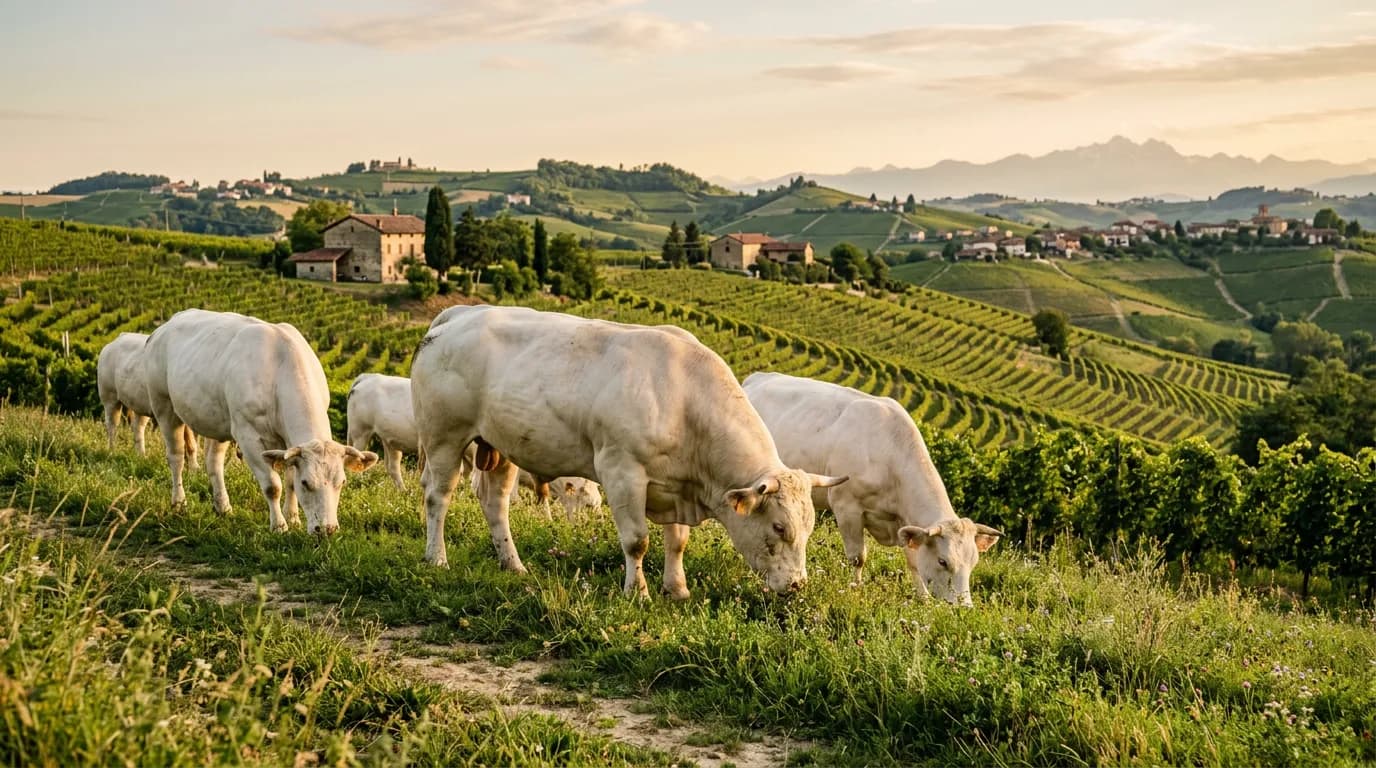
Piedmontese cattle display a striking physical appearance that immediately distinguishes them from other breeds. The coat color is characteristically white to pale grey in adults, with calves born wheat-colored (fromentino) and gradually lightening as they mature. The muzzle, tongue, palate, and skin around the eyes are dark pigmented — a trait known as 'black points' — providing natural protection against solar radiation.
The breed's conformation is defined by the double-muscled phenotype. Piedmontese cattle exhibit prominently rounded hindquarters with deep, heavily muscled thighs, a broad and well-muscled back, visible muscle definition through the shoulder, forearm, and loin, and a relatively fine bone structure in proportion to muscle mass. The overall impression is of a compact, heavily muscled animal with clean lines and minimal subcutaneous fat.
Mature Piedmontese bulls typically weigh 850-1,000 kg, while cows range from 500-650 kg. The breed is moderate in frame size compared to the largest Continental types — smaller than Charolais or Simmental but larger than British breeds like Angus or Hereford. The moderate frame combined with exceptional muscular development produces a remarkably high meat-to-bone ratio.
Carcass characteristics are where the Piedmontese truly excels. Dressing percentages routinely reach 65-68% — among the highest of any breed worldwide. The carcass is characterized by an exceptionally high proportion of premium cuts (loin, tenderloin, rump, and round), minimal waste fat, and fine-grained meat texture. EU carcass classification grades of E and U are standard for well-finished Piedmontese, reflecting the breed's outstanding conformation.
The skin of Piedmontese cattle is notably thin and fine — a characteristic that facilitates the muscular definition visible through the coat but also means the breed is somewhat less hardy in extreme cold than thick-skinned breeds. This is rarely a concern in the breed's native Piedmont environment or in the housed finishing systems typical of Italian beef production.
Meat Quality and Nutritional Profile
The meat quality of Piedmontese cattle is the breed's primary claim to commercial distinction and the foundation of its premium market position. The unique combination of extreme leanness, tenderness, and distinctive flavor profile sets Piedmontese beef apart from virtually all other breeds and has earned it protected status and regional identity recognition in Italian markets.
The defining characteristic of Piedmontese beef is its extraordinary leanness. Total fat content in major cuts averages 1.5-2.5%, with some cuts falling below 1% — figures that rival poultry and fish. Despite this extreme leanness, the meat maintains impressive tenderness scores in objective measurements. Warner-Bratzler shear force values for Piedmontese beef are consistently lower (indicating greater tenderness) than for many fattier breeds, a seeming paradox explained by the increased number of smaller-diameter muscle fibers and the reduced collagen cross-linking characteristic of myostatin-affected muscle.
The nutritional profile of Piedmontese beef is exceptional by red meat standards. Protein content averages 21-23% — among the highest of any beef breed. Cholesterol content is typically 40-50 mg per 100g, significantly below the average for conventional beef. The fatty acid profile shows a relatively favorable ratio of unsaturated to saturated fats, and iron content is high, providing good bioavailability of this essential mineral.
The flavor profile of Piedmontese beef is subtle and refined, lacking the intense 'beefy' taste associated with highly marbled breeds. Italian consumers familiar with the breed appreciate its clean, slightly sweet flavor and smooth texture. The meat is pale pink to light red in color — lighter than most beef breeds — with a fine, smooth grain that presents attractively in retail display.
Culinary versatility is another advantage. Piedmontese beef performs exceptionally well in traditional Piedmontese preparations such as carne cruda (raw beef tartare), brasato al Barolo (braised in Barolo wine), and bollito misto (mixed boiled meats). The breed's leanness makes it forgiving in preparations where excessive fat would be undesirable, while its tenderness ensures good results even in quick-cooking methods.
These quality attributes have driven the development of branded Piedmontese beef programs and regional quality marks. The Consorzio di Tutela della Razza Piemontese works to promote and protect the breed's market identity, and Piedmontese beef commands a significant premium — typically 20-40% above conventional beef prices — in Italian retail and food service markets.
Italian Market Premium and Positioning
The Piedmontese breed occupies a unique and privileged position in the Italian beef market. As Italy's premier native beef breed, it benefits from strong regional identity, consumer loyalty in its home market, and a well-established premium pricing structure that reflects the breed's distinctive quality attributes.
In the Piedmont region itself, Piedmontese beef is deeply embedded in local food culture. Restaurants, butcher shops, and food festivals celebrate the breed, and consumers willingly pay premium prices for authenticated Piedmontese product. The traditional 'Fassona' or 'Fassone' designation — referring to the characteristic double-muscled conformation — serves as a quality signifier that communicates breed identity and expected eating quality to Italian consumers.
Pricing for Piedmontese beef reflects its premium positioning. At the slaughter level, Piedmontese carcasses typically command prices 20-40% above the average for conventional beef carcasses in Italian markets. For specific premium cuts — particularly the tenderloin, rib-eye, and the traditional 'battuta' (hand-chopped tartare cut) — the premium can be significantly higher. This pricing structure creates strong economic incentives for producers and finishers who can supply consistent quality to the market.
The buyer base for Piedmontese beef is concentrated in quality-oriented channels. Specialist butcher shops (macellerie) throughout Piedmont and northern Italy are the traditional primary channel, with increasingly important volumes moving through premium supermarket programs and high-end food service. Export markets — particularly in the United States, Japan, and northern Europe — are growing as international awareness of Piedmontese quality increases.
For professional livestock buyers and fattening operators, the Piedmontese market premium creates an interesting economic calculation. While the breed's management costs are higher than for conventional beef cattle — primarily due to calving management requirements — the premium returns available can produce attractive margins for operators with the specialist skills and facilities to manage the breed effectively.
Bovatra works with buyers who have specific interest in Piedmontese genetics, providing market intelligence, sourcing support for breeding stock, and connections to the established Piedmontese production network in Italy.
Breeding Considerations and Calving Management
Breeding Piedmontese cattle requires specialized knowledge and management practices that distinguish it from conventional beef production. The myostatin mutation that gives the breed its exceptional carcass characteristics also creates specific challenges — most significantly in reproductive management — that must be understood and planned for by any professional entering Piedmontese production.
Calving difficulty is the breed's most significant management challenge. The double-muscled conformation of Piedmontese calves — particularly the broadened hindquarters and increased muscle mass through the shoulders — frequently prevents natural unassisted birth. In purebred Piedmontese herds, caesarean section rates of 50-70% are common, and some herds report rates exceeding 80%. This is significantly higher than any other commercially important beef breed and represents a substantial management cost.
Effective calving management in Piedmontese herds requires round-the-clock monitoring of cows approaching parturition, skilled stockmanship to assess when intervention is necessary, reliable veterinary support available at short notice for caesarean procedures, appropriate facilities for post-operative cow care and calf management, and careful selection of sires with known calving ease genetic merit.
Genetic improvement for calving ease has been a priority of ANABORAPI's breeding program, and progress has been made through estimated breeding values (EBVs) that identify sires with lower calving difficulty. However, the strong genetic correlation between muscular development and calving difficulty means that reducing dystocia without sacrificing the breed's defining carcass characteristics remains a delicate balancing act.
Crossbred Piedmontese production offers an alternative that mitigates calving difficulties while still capturing some of the breed's meat quality advantages. Using Piedmontese sires on cows of larger-framed, wider-pelvis breeds (such as Charolais or Simmental) reduces the incidence of dystocia while producing crossbred calves with improved muscling and leanness compared to the dam breed. This approach is increasingly popular in Italian commercial beef production.
Fertility and reproductive efficiency in Piedmontese cattle are generally good when calving management is handled effectively. Calving intervals of 365-400 days are achievable, and conception rates are competitive with other beef breeds. The breed's moderate milk production is adequate for calf rearing, though supplementary feeding may be needed in some management systems.
Feeding and Finishing Piedmontese Cattle
Feeding and finishing Piedmontese cattle requires an understanding of how the breed's unique physiology — specifically the myostatin-related changes in metabolism and body composition — affects nutritional requirements and finishing outcomes.
The most important nutritional characteristic of Piedmontese cattle is their reduced capacity for fat deposition. While this trait produces the ultra-lean carcasses that the market values, it also means that energy partitioning in Piedmontese cattle differs from conventional breeds. A higher proportion of dietary energy is directed toward muscle protein synthesis rather than fat storage. Consequently, protein requirements are relatively higher, and the risk of over-fattening — a common concern with other breeds — is minimal with Piedmontese.
Typical finishing rations for Piedmontese cattle in Italian operations are based on maize silage and cereal grain concentrates, similar to those used for other breeds, but with attention to higher crude protein levels — typically 14-16% on a dry matter basis, compared to 12-14% for conventional breeds. Energy density targets of 11.5-12.5 MJ metabolizable energy per kg dry matter support the breed's growth potential without producing excessive fat cover.
Average daily gains for Piedmontese cattle in finishing systems typically range from 1.1-1.4 kg per day — moderate compared to large-frame Continental breeds but producing carcasses of exceptional composition. Feed conversion ratios of 6:1 to 7.5:1 are typical, with the favorable ratio partly reflecting the breed's efficient protein deposition and low fat waste.
Target slaughter weights for Piedmontese cattle vary by market specification but typically range from 600-700 kg liveweight for young bulls (vitelloni), producing carcasses of 390-470 kg. The breed's exceptional dressing percentage means that even at moderate liveweights, carcass weights are competitive with larger-framed breeds finished to heavier weights.
Water requirements, mineral supplementation, and vitamin provisions follow general beef cattle guidelines, though attention should be paid to calcium and phosphorus balance given the breed's high rate of muscle protein synthesis. The finishing period typically lasts 4-6 months for store cattle entering at 350-450 kg, with careful monitoring of condition to achieve optimal market-ready finish without excess fat.
Specialist Buyer Interest and Niche Markets
The Piedmontese breed attracts a distinct category of specialist buyers whose interest is driven by the breed's unique quality attributes and the premium market positioning these attributes support. Understanding the motivations and requirements of these specialist buyers provides context for the breed's market dynamics and future prospects.
In Italy, the primary buyers of Piedmontese cattle for finishing are specialist fattening operators in the Piedmont region — often family-run operations with multi-generational experience in the breed. These operators have the specialized skills, facilities, and veterinary relationships needed to manage the breed's calving requirements and finishing protocols. Their proximity to the breed's primary markets in Turin, Milan, and the broader Piedmont-Lombardy corridor provides logistical advantages for marketing finished animals.
Quality-focused processors and abattoirs represent another key buyer category. These operations seek Piedmontese cattle specifically for branded beef programs, premium retail supply, and food service accounts. The consistency of Piedmontese carcass quality — high conformation, exceptional leanness, and predictable eating quality — makes the breed attractive to processors who need reliable supply for premium programs.
International interest in Piedmontese genetics has grown significantly in recent decades. Breeding stock and semen exports to North America, South America, Australia, and other European countries have expanded the breed's global footprint. In the United States, the North American Piedmontese Association promotes the breed for its lean beef characteristics, targeting health-conscious consumers and premium grass-fed beef programs.
For Italian fattening operators who do not specialize in Piedmontese, the breed can still play a role in procurement strategy through crossbreeding. Piedmontese-sired calves out of Charolais, Limousin, or other Continental dams combine improved muscling and leanness with more manageable calving and the commercial familiarity of the dam breed type. These crossbred animals can be finished alongside other breed types in conventional fattening operations.
Bovatra facilitates access to the Piedmontese market for buyers at various levels of involvement — from sourcing crossbred store cattle for conventional finishing to connecting specialist operators with purebred breeding stock and market channels.
The Future of Piedmontese and Working with Bovatra
The Piedmontese breed stands at an interesting intersection of tradition and innovation. Its centuries-old heritage in the Piedmont region provides a deep cultural foundation, while its unique genetic characteristics align remarkably well with contemporary consumer trends toward leaner, healthier, and more sustainably produced meat.
Several trends support a positive outlook for the breed's market position. Consumer demand for lean, high-protein meat continues to grow across European markets, and Piedmontese beef is perhaps the ultimate expression of lean beef quality. Increasing interest in traceability, regional identity, and artisanal food production favors breeds with strong provenance stories — and the Piedmontese has one of the most compelling in European agriculture.
Genetic improvement programs managed by ANABORAPI continue to refine the breed's performance. Genomic selection tools are being applied to improve calving ease without compromising carcass merit, and breeding values for growth, muscularity, and maternal traits are becoming increasingly accurate. These advances promise to gradually address the breed's management challenges while maintaining and enhancing its quality advantages.
The expansion of Piedmontese crossbreeding in Italian commercial beef production is also likely to continue. As more fattening operators seek to differentiate their product in competitive markets, the ability to use Piedmontese sires on commercial cow herds to produce calves with superior carcass attributes is an increasingly attractive strategy.
For professional livestock buyers engaging with the Piedmontese breed, Bovatra provides several forms of support. We offer market intelligence on Piedmontese pricing trends and demand patterns, sourcing support for Piedmontese and Piedmontese-cross store cattle, connections to the established Piedmontese production and processing network, and guidance on the management requirements and economics of Piedmontese finishing.
Whether your interest in Piedmontese is as a primary breed focus or as a complementary element in a diversified procurement strategy, Bovatra can help you navigate this specialist market segment. Contact us to discuss how Piedmontese genetics can add value to your livestock operation.
Source Piedmontese Cattle
Related Guides

Charolais Cattle Breed Guide: Characteristics, Feeding & Sourcing
Everything professional buyers need to know about Charolais cattle — from breed characteristics and growth performance to sourcing from France and transport to Italy.
Cattle Fattening in Italy: Breeds, Systems & Best Practices
An in-depth guide to Italy's cattle fattening industry — covering major regions, system types, preferred breeds, feeding programs, vitellone production, and economic considerations for professional operators.
How to Choose the Right Cattle Breed for Fattening in Italy
A practical decision guide for Italian fattening operations — comparing breeds by growth rate, feed efficiency, carcass yield, and market premiums to help you choose the right cattle for your system.
Ready to Source Livestock — or List Your Stock?
Whether you are a buyer looking for specific breeds or a seller seeking reliable access to European buyers, Bovatra manages the full transaction cycle.