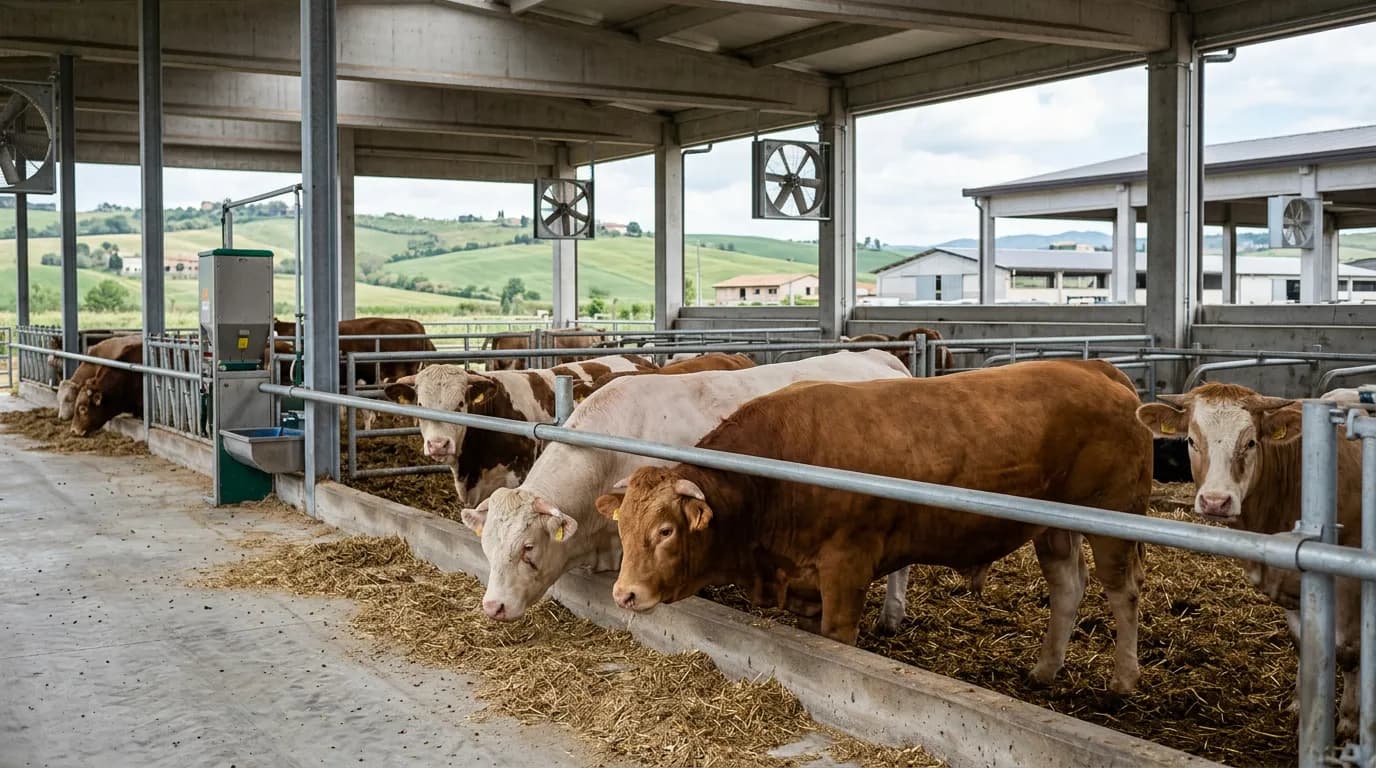
How to Choose the Right Cattle Breed for Fattening in Italy
A practical decision guide for Italian fattening operations — comparing breeds by growth rate, feed efficiency, carcass yield, and market premiums to help you choose the right cattle for your system.
Table of Contents
Why Breed Selection Matters for Fattening Profitability
The choice of cattle breed is one of the most consequential decisions a fattening operator makes. It directly determines growth potential, feed requirements, finishing duration, carcass characteristics, and ultimately the price received at slaughter. Yet breed selection is often treated as a matter of habit or supplier availability rather than as the strategic business decision it truly is.
In Italy's competitive beef fattening sector — concentrated in the Po Valley, Veneto, Lombardy, Piedmont, and Emilia-Romagna — margins are tight and the difference between profit and loss often comes down to the interplay between purchase cost, daily feed cost, days on feed, and slaughter value. Each breed brings a different equation to this calculation.
The ideal breed for your operation depends on multiple factors: your target market (premium retail, food service, processing), your feeding system and infrastructure, the availability and cost of feed ingredients in your region, your management capacity and labor resources, and the seasonal patterns of your procurement and marketing calendar.
There is no single "best breed" for all operations. A large-scale feedlot targeting volume production of standardized young beef will optimize around different breed characteristics than a smaller operation producing premium-branded product for high-end retail. This guide provides the comparative framework to help you make an informed breed selection that aligns with your specific business objectives.
Bovatra works with fattening operations across Italy, sourcing multiple breeds from our European supplier network. We understand that breed selection is not a one-size-fits-all decision, and we help buyers develop procurement strategies that match the right genetics to their operation's requirements.
Key Factors to Consider
Before comparing specific breeds, it is important to establish the decision criteria that should drive breed selection for a fattening operation.
Target market is the starting point. Italian beef markets have distinct quality requirements and price structures. The vitellone market (young beef from bulls slaughtered at 14–20 months) is the primary outlet for fattened cattle in Italy and rewards good conformation and moderate fat cover. Premium branded programs may specify particular breeds or quality grades. The processing market is less discriminating on breed but more sensitive to purchase price. Understanding exactly where your finished cattle will be sold — and what the buyer requires — is the essential first step.
Feed costs are typically the largest single expense in a fattening operation, often representing 60–70% of total variable costs. Different breeds have different feed requirements both in terms of quantity (daily dry matter intake) and quality (energy density needed to achieve target growth rates). In regions where feed is expensive — or in periods of high cereal prices — breeds with superior feed conversion efficiency deliver better margins.
Finishing period duration affects both the total feed cost per animal and the capital turnover of the operation. Breeds that reach target slaughter weight and condition faster allow more animals to pass through the same facilities in a year, improving capital efficiency. However, faster finishing is not always better — some markets reward the flavor development that comes with a longer, slower finishing period.
Carcass requirements vary by market outlet. Key carcass parameters include killing-out percentage (dressing percentage), conformation score (EUROP grid), fat class, carcass weight, and meat color and pH. Different breeds produce systematically different carcass outcomes, and selecting a breed that naturally aligns with your target carcass specification reduces the need for compensatory management adjustments.
Purchase cost and availability must be considered alongside biological performance. A breed with theoretically superior growth rates may not be the best choice if it commands a significant premium at purchase and is difficult to source in consistent quality and quantity. The total economics from purchase through finishing to slaughter — not just biological performance in isolation — determine profitability.
Animal health and management requirements differ between breeds. Some breeds are more susceptible to specific health challenges during the finishing period, while others require different handling facilities or management approaches. The cost and complexity of health management should factor into breed selection.
Charolais: The Growth Champion
Charolais cattle are the most widely used breed in Italian fattening operations and set the benchmark for growth performance in European finishing systems.
Growth performance is the Charolais breed's defining strength. Under typical Italian finishing conditions, Charolais young bulls achieve average daily gains of 1.3–1.6 kg per day, with top-performing animals reaching 1.8 kg or more. This growth rate is the highest of any commonly available breed in the European market, allowing Charolais to reach target slaughter weights of 650–750 kg in relatively short finishing periods of 4–6 months from a typical broutard entry weight of 350–450 kg.
Carcass characteristics are excellent. Charolais cattle typically achieve dressing percentages of 60–65%, conformation scores of U to E on the EUROP grid, and lean carcasses with moderate fat cover. The meat is characteristically pale in color and lean, which aligns well with Italian consumer preferences for light-colored, low-fat beef.
Feed efficiency is competitive, with feed conversion ratios typically in the range of 5.5:1 to 7:1 (kg dry matter per kg live weight gain). The combination of high growth rate and reasonable feed efficiency means that Charolais achieve the lowest cost per kilogram of gain among the major beef breeds available in Europe.
Considerations: Charolais cattle can have a more spirited temperament than some alternatives, requiring adequate handling facilities. Their purchase price as broutards from France tends to be at the higher end of the market, though this is offset by superior finishing performance. The breed's popularity means that supply is generally reliable, particularly from France during the main autumn buying season.
Best suited for: Large-scale fattening operations targeting the mainstream vitellone market, operations with high-energy feeding systems (TMR based on maize silage and concentrates), and buyers seeking maximum growth rate and carcass yield.
Limousin: Premium Carcass Quality
Limousin cattle are the second most popular breed in Italian fattening and are valued for their exceptional carcass quality and meat characteristics.
Growth performance is good but slightly below Charolais. Limousin young bulls typically achieve average daily gains of 1.1–1.4 kg per day in Italian finishing systems. While this is lower than Charolais, Limousin cattle are more efficient converters of feed to carcass weight due to their lighter bone structure and superior dressing percentage.
Carcass characteristics are where Limousin truly excels. The breed typically achieves dressing percentages of 62–66% — among the highest of any breed — with very fine bone and a high proportion of saleable meat. Conformation scores are consistently U or better, with low external fat cover. The meat is fine-grained, tender, and well-colored, making it highly valued by Italian processors and retailers.
Feed efficiency on a live-weight basis is similar to or slightly better than Charolais, typically 5.5:1 to 6.5:1. When measured on a carcass-weight basis, Limousin often outperforms Charolais due to the higher dressing percentage — meaning more of every kilogram of feed is converted to saleable meat.
Considerations: Limousin cattle generally have a calmer temperament than Charolais, which can reduce handling stress and improve meat quality at slaughter. Their slightly lower growth rate means a longer finishing period to reach the same live weight, but the higher dressing percentage compensates when calculating carcass value. Limousin broutards from France are typically priced at a slight premium to Charolais on a live-weight basis, reflecting the breed's carcass quality advantages.
Best suited for: Operations targeting premium retail or branded beef markets, facilities where temperament and handling ease are important, buyers who prioritize carcass yield and meat quality over maximum live-weight growth rate, and systems where the finishing period can be slightly longer (5–7 months).
Simmental/Fleckvieh: The Versatile Performer
Simmental (Fleckvieh) cattle from Germany and Austria offer a versatile option that combines good beef characteristics with the robustness of a dual-purpose breed.
Growth performance is solid, with average daily gains of 1.2–1.5 kg per day in Italian finishing systems. While not matching the peak growth rates of Charolais, Simmental cattle offer consistent and reliable performance across a range of management and feeding conditions.
Carcass characteristics reflect the breed's dual-purpose heritage. Dressing percentages are typically 56–60% — lower than the specialized French beef breeds — due to slightly heavier bone and larger organs. Conformation scores are generally R to U on the EUROP grid. However, Simmental carcasses typically carry more intramuscular fat (marbling) than Charolais or Limousin, which can be an advantage for eating quality and specific market segments.
Feed efficiency is competitive at 5.5:1 to 7:1, broadly comparable to Charolais. Simmental cattle are known for their adaptability to different feeding systems and their ability to maintain growth performance on a wider range of diet qualities than some more specialized beef breeds.
Considerations: Simmental cattle are generally docile and easy to manage, with strong legs and feet that perform well on both slatted and solid-floor housing. Their purchase price from German and Austrian auctions is typically competitive, and the short transport distance via the Brenner Pass keeps total landed cost low. The lower dressing percentage compared to Charolais and Limousin means that live-weight economics and carcass-weight economics may tell different stories — buyers should model both scenarios.
Best suited for: Operations seeking a robust, easy-to-manage breed with consistent performance, buyers with access to German/Austrian markets and wanting to minimize transport distance and cost, systems targeting markets where moderate marbling is valued, and operations where feed quality or availability is variable.
Angus: Premium Market Positioning
Aberdeen Angus cattle occupy a growing niche in the Italian market, driven by consumer recognition of the Angus brand and its association with premium eating quality.
Growth performance in Italian finishing systems is moderate, with average daily gains of 1.0–1.3 kg per day for Angus young bulls. Angus are an early-maturing breed, meaning they deposit fat at lighter weights and younger ages than Continental breeds. This characteristic makes them best suited to finishing systems that target moderate slaughter weights of 550–650 kg rather than the heavier weights typical of Continental breed production.
Carcass characteristics differ significantly from Continental breeds. Dressing percentages are typically 55–59%, lower than Charolais or Limousin. However, Angus carcasses are characterized by superior intramuscular fat (marbling), which is associated with enhanced tenderness, juiciness, and flavor. Fat cover tends to be moderate to heavy by Italian standards, which can result in higher trimming losses but better eating quality.
Feed efficiency on a live-weight basis is typically 6:1 to 7.5:1, which is less favorable than Continental breeds. However, when measured per unit of quality-graded carcass, the economics can be competitive if the market pays a premium for Angus-branded or marbled beef.
Considerations: Angus cattle have excellent temperaments and are among the easiest breeds to manage in finishing systems. They are well-suited to less intensive feeding programs and can perform satisfactorily on lower-energy rations. Angus cattle are typically sourced from Ireland, the UK, or from Continental crossbreeding programs. The Angus brand carries significant consumer recognition in Italy and commands price premiums of 10–30% over unbranded beef in retail channels.
Best suited for: Operations targeting premium and branded beef programs where Angus breed identity adds value, smaller or specialized operations producing for high-end retail and food service, systems using moderate-energy feeding programs, and buyers who prioritize eating quality and consumer brand recognition over maximum carcass yield.
Growth Rate vs Feed Efficiency Trade-offs
One of the most important — and most misunderstood — aspects of breed selection is the relationship between growth rate and feed efficiency. These two traits are related but not identical, and understanding their interaction is crucial for economic decision-making.
Growth rate measures how quickly an animal gains weight, typically expressed as average daily gain (ADG) in kilograms per day. Feed efficiency (or feed conversion ratio, FCR) measures how much feed is required to produce a kilogram of weight gain. A breed can have a high growth rate but moderate feed efficiency (because it eats a lot to achieve that growth), or moderate growth rate but excellent feed efficiency (because it converts a high proportion of what it eats into body tissue).
In practice, the breeds available for Italian fattening generally show the following ranking. For growth rate (highest to lowest): Charolais, Simmental, Limousin, Angus. For feed efficiency (best to least favorable): Limousin, Charolais, Simmental, Angus. For carcass yield (highest to lowest): Limousin, Charolais, Simmental, Angus.
These rankings reveal important trade-offs. Charolais has the highest absolute growth rate, but Limousin may convert feed to carcass meat more efficiently due to its superior dressing percentage and lower maintenance requirements. Simmental sits in the middle on most parameters, offering versatility without excelling on any single metric. Angus trails on biological efficiency but can compensate through market premiums.
The economic implications depend heavily on local conditions. When feed costs are high, breeds with better feed efficiency (Limousin) become relatively more attractive. When the market is paying strong premiums for heavy, lean carcasses, breeds with high growth rates (Charolais) are favored. When branded beef programs offer significant premiums, the breed identity (Angus) can override biological performance differences.
The most profitable breed is not the one with the best biological performance — it is the one that maximizes the difference between total revenue and total cost in your specific operation. Bovatra helps buyers model these trade-offs using current market data and operation-specific cost structures.
Market Premiums by Breed
The Italian beef market assigns different values to different breeds, and understanding these market premiums is essential for breed selection.
At the live-animal level, breed premiums are reflected in the purchase price. Charolais and Limousin broutards from France consistently trade at the highest prices, reflecting their established reputation and strong demand from Italian fatteners. Simmental/Fleckvieh cattle from Germany and Austria are priced competitively, often 5–15% below equivalent-weight French beef breeds. Angus cattle from Ireland vary in price but are often attractively priced relative to Continental breeds.
At the carcass level, premiums are determined by conformation, fat class, and carcass weight — all of which are strongly influenced by breed. Carcasses grading U or E on the EUROP conformation scale command premiums of EUR 0.10–0.30 per kg carcass weight over R-graded carcasses. Breeds that consistently achieve U or E grades (Charolais, Limousin) therefore generate higher carcass values.
At the retail level, breed-specific branding can add significant value. Angus-branded beef programs in Italian supermarkets typically command retail premiums of 15–30% over unbranded beef. While only a portion of this retail premium reaches back to the producer, it can meaningfully improve the economics of Angus fattening. Charolais and Limousin are less commonly marketed under breed-specific brands in Italy, though some regional programs exist.
The Piedmontese breed deserves mention as the native Italian premium breed. While not typically imported for fattening (it is produced domestically), Piedmontese beef commands the highest premiums in Italian markets — often 30–50% above standard beef — due to its exceptional muscling, tenderness, and very low fat content. Operations in Piedmont and neighboring regions should consider the economics of local Piedmontese production alongside imported breed options.
Bovatra monitors breed-specific market premiums across Italian slaughter plants and retail channels, providing buyers with current data to inform breed selection decisions.
Seasonal Availability and Procurement Planning
Breed selection is not only a biological and economic decision — it is also constrained by the practical reality of when and where different breeds are available for purchase.
Charolais availability peaks from September through December, when the bulk of spring-born French broutards reach weaning age and enter the market. A secondary window exists from March through May for autumn-born calves. Outside these windows, Charolais supply is limited and prices tend to be higher on a per-head basis. Buyers who rely heavily on Charolais must plan their procurement calendar around these seasonal patterns.
Limousin follows a similar seasonal pattern to Charolais, as both breeds are primarily produced in French suckler herds with spring and autumn calving. However, Limousin volumes are smaller than Charolais, meaning that competition for quality Limousin animals can be particularly intense during peak season.
Simmental/Fleckvieh from Germany and Austria has more evenly distributed availability throughout the year, as the dual-purpose Fleckvieh production system produces calves more continuously than the strongly seasonal French suckler system. Auctions operate year-round with relatively stable supply. This more consistent availability makes Fleckvieh a useful stabilizing element in a multi-breed procurement program.
Angus from Ireland follows a strong seasonal pattern similar to France, with weanlings available primarily from September through November. Store cattle (older animals) are available from March through summer, providing a secondary procurement window.
For fattening operations that run continuously — filling and marketing animals throughout the year — relying on a single breed from a single origin creates vulnerability to seasonal supply and pricing fluctuations. A diversified procurement strategy that incorporates multiple breeds from different origins can smooth supply across the year, reduce exposure to any single market's pricing volatility, and provide flexibility to shift procurement toward whichever breed offers the best current value.
Bovatra develops year-round procurement plans for fattening operations, balancing breed preferences with seasonal availability and cost considerations to optimize continuous supply.
Mixing Breeds in Fattening Lots and Making Your Decision
Many Italian fattening operations run mixed-breed lots, either by choice or by necessity. Understanding how to manage breed diversity within a fattening facility is a practical reality of the business.
The case for single-breed lots is strongest in operations targeting specific market specifications. When a slaughter plant or retail customer requires a uniform product — consistent carcass weights, conformation grades, and fat classes — single-breed lots are easier to manage toward this uniformity. Feeding programs can be precisely calibrated to the breed's requirements, and marketing timing can be optimized around the breed's growth curve.
The case for mixed-breed lots is primarily practical. Few operations can fill their entire facility with a single breed at the optimal time and price. Mixing breeds allows procurement flexibility, risk diversification, and the ability to capitalize on favorable pricing opportunities across different breed markets. Mixed lots also allow the operation to test different breeds before committing to a single-breed strategy.
When running mixed-breed lots, the key management principle is to group animals by expected finishing date rather than by breed. Animals of similar weight and expected growth trajectory — regardless of breed — should be penned together so they can be marketed as a uniform group. This means that lighter Angus and heavier Charolais entering on the same day should likely be managed in separate groups, while Charolais and Simmental of similar weight can often be grouped together.
Feeding management for mixed lots should target the median requirements of the group, with adjustments made through pen allocation rather than individual ration formulation. Monitor growth performance by breed within mixed lots to build your own performance database and refine future procurement decisions.
The right breed decision depends on your specific circumstances — there is no universal answer. Evaluate the factors discussed in this guide against your operation's target market, cost structure, infrastructure, and management capacity. If you are unsure where to start, begin with small trial lots of different breeds to generate your own performance data before scaling up.
Bovatra is ready to support your breed selection process with market intelligence, performance data, and access to our multi-country, multi-breed sourcing network. Contact us to discuss your fattening operation's requirements and develop a procurement strategy that maximizes your profitability.
Discuss Breed Selection
Related Guides
Cattle Fattening in Italy: Breeds, Systems & Best Practices
An in-depth guide to Italy's cattle fattening industry — covering major regions, system types, preferred breeds, feeding programs, vitellone production, and economic considerations for professional operators.

Charolais Cattle Breed Guide: Characteristics, Feeding & Sourcing
Everything professional buyers need to know about Charolais cattle — from breed characteristics and growth performance to sourcing from France and transport to Italy.

Angus Cattle Breed Guide: Quality, Sourcing & Feeding
A comprehensive guide to Angus cattle for professional buyers — covering breed traits, marbling quality, branded beef programs, Irish sourcing, and transport logistics to Italy.
Ready to Source Livestock — or List Your Stock?
Whether you are a buyer looking for specific breeds or a seller seeking reliable access to European buyers, Bovatra manages the full transaction cycle.