Buying Cattle From Germany: Simmental, Holstein & Sourcing Guide
A complete guide to sourcing cattle from Germany and Austria — covering key breeds, auction systems, regional differences, quality standards, export documentation, and transport routes to Italy.
Table of Contents
Germany's Livestock Market Overview
Germany is Europe's largest economy and one of its most significant cattle producers, with a national herd of approximately 11 million head. While Germany is primarily known for its dairy sector — being the EU's largest milk producer — the country also produces substantial numbers of beef cattle and dual-purpose animals that are highly relevant to Italian fattening operations.
The German livestock market is characterized by its high level of organization, strict quality controls, well-established auction systems, and a strong tradition of breed improvement through systematic genetic programs. For Italian buyers, Germany and neighboring Austria represent important sourcing origins, particularly for Simmental/Fleckvieh and Brown Swiss breeds that are valued in Italian markets for their dual-purpose qualities and meat characteristics.
Germany exports approximately 300,000–400,000 live cattle annually, with significant volumes destined for southern European fattening operations. The geographic proximity to Italy — particularly the short transport distance from Bavaria through the Brenner Pass — makes German cattle an efficient and economically attractive sourcing option.
The German-Austrian cattle market effectively functions as a single market for practical purposes, with similar breeds, shared auction platforms, and harmonized quality standards. Austrian Simmental and Brown Swiss cattle are often marketed alongside German animals through the same channels, and Italian buyers commonly source from both countries within a single procurement program.
Key Breeds: Simmental/Fleckvieh
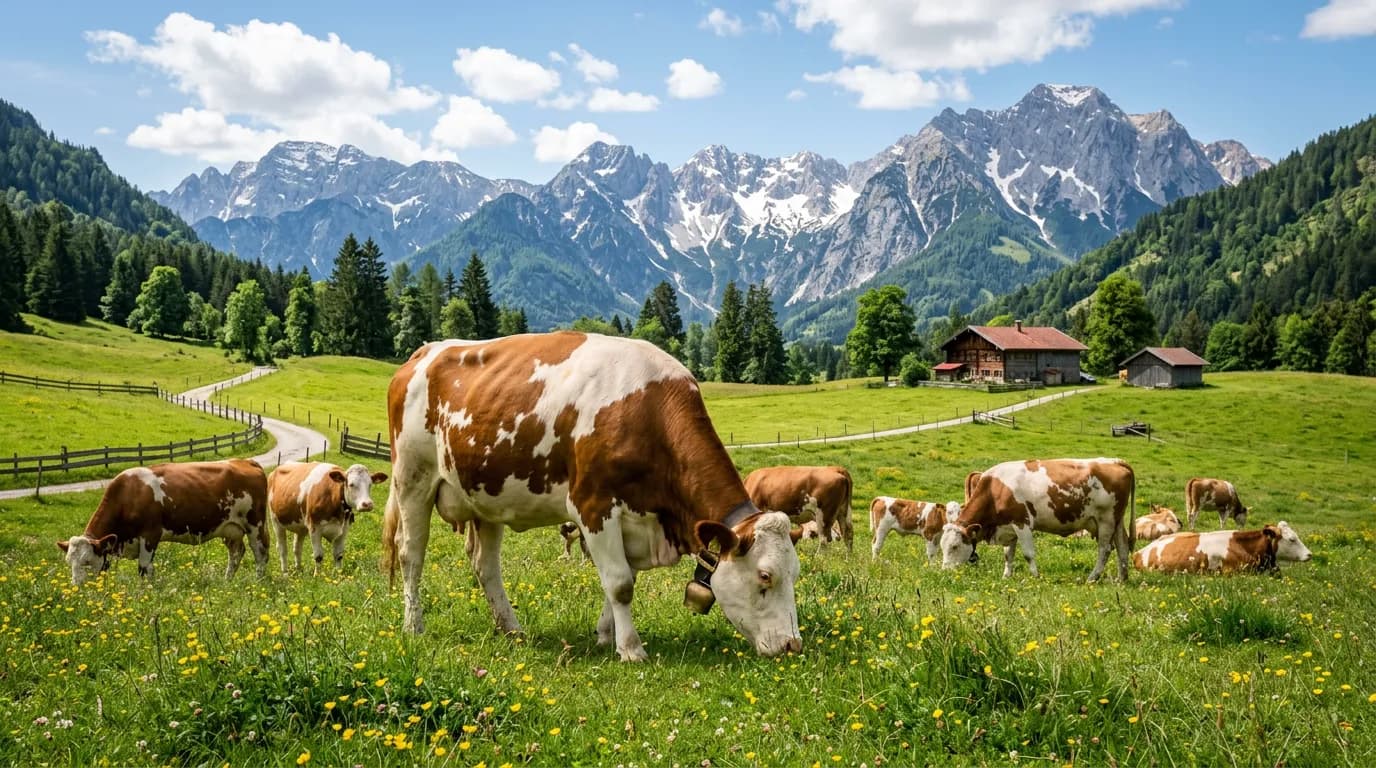
The Simmental, known as Fleckvieh in German-speaking countries, is by far the most important breed for Italian buyers sourcing from Germany and Austria. With approximately 4.5 million Fleckvieh cattle in Germany and 2 million in Austria, this breed dominates the cattle population of the Alpine and southern German regions.
Fleckvieh is a true dual-purpose breed, selected for both milk production and beef characteristics. This dual-purpose heritage gives Fleckvieh cattle several distinctive advantages for fattening operations. They combine good muscular development with moderate frame size, strong skeletal structure, and excellent feed conversion. Mature Fleckvieh bulls weigh 1,100–1,300 kg, while cows typically reach 700–850 kg.
For Italian fattening operations, Fleckvieh cattle offer average daily gains of 1.2–1.5 kg in well-managed finishing systems, dressing percentages of 56–60% (slightly lower than pure beef breeds like Charolais), excellent meat quality with good intramuscular fat distribution, and strong legs and feet suited to various housing systems.
Fleckvieh calves and store cattle destined for Italian fattening are typically purchased at 150–350 kg live weight for dairy-cross calves or 300–450 kg for purebred beef-type Fleckvieh. The breed adapts well to Italian feeding systems based on maize silage and concentrate rations.
The German and Austrian Fleckvieh breeding programs are among the most advanced in the world, utilizing genomic selection, extensive performance testing, and comprehensive recording systems. This genetic infrastructure means that Fleckvieh cattle available for export are generally well-documented animals with reliable performance potential.
Buyers should be aware that there is significant variation within the Fleckvieh population between dairy-type and beef-type animals. German Fleckvieh tends to be slightly more dairy-oriented than Austrian Fleckvieh, which has maintained a stronger beef component. For fattening purposes, buyers should specify beef-type or dual-purpose type animals and avoid heavily dairy-selected lines that may underperform in finishing systems.
Key Breeds: Holstein-Friesian and Others
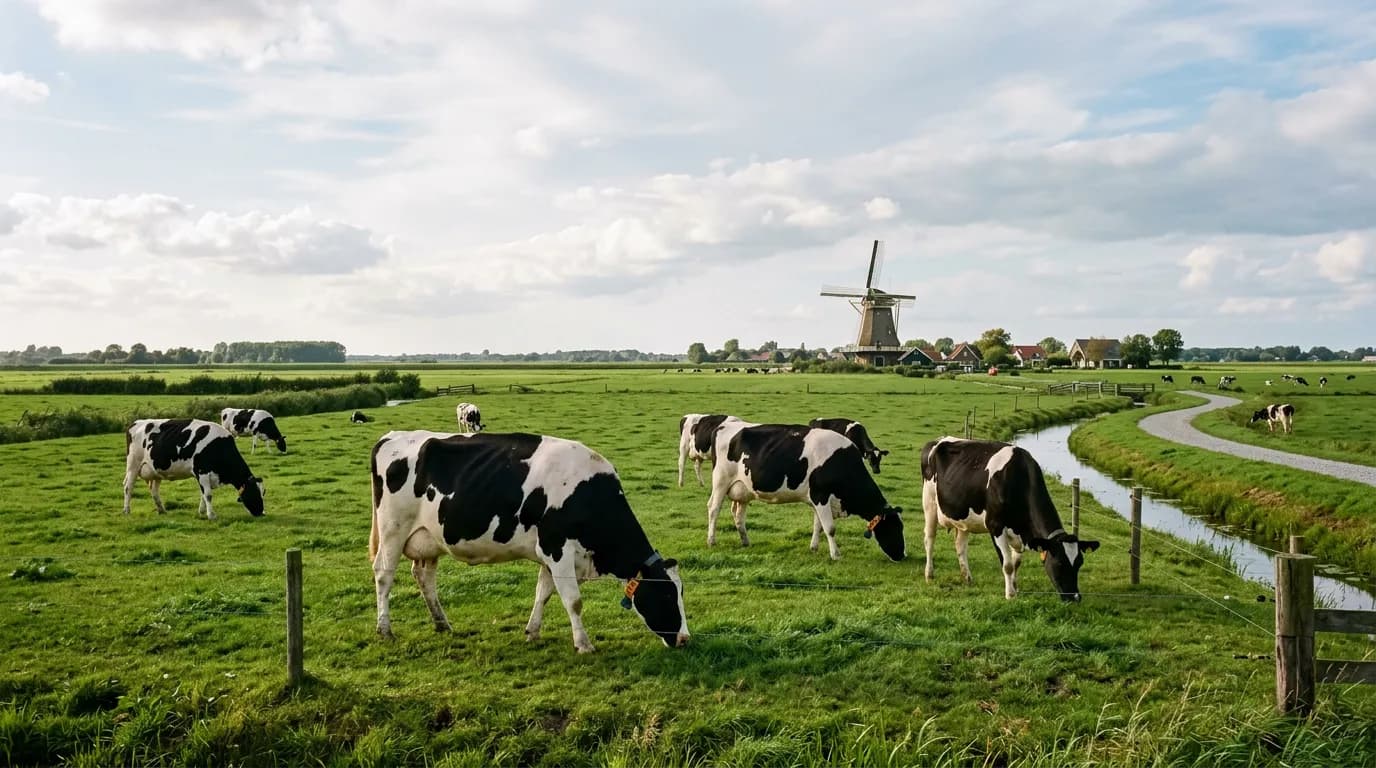
Holstein-Friesian cattle represent the largest single breed in Germany, with approximately 5 million head concentrated in the northern German lowlands. While Holsteins are primarily dairy animals, bull calves and cull cows from the dairy herd represent a significant source of animals for fattening.
Holstein bull calves are available in very large numbers — Germany's dairy herd produces approximately 2.5 million calves annually, of which roughly half are male. These calves can be purchased at young ages (14–28 days, 45–60 kg) at competitive prices and raised in Italian veal or young bull fattening systems. Holstein bulls typically achieve average daily gains of 1.0–1.3 kg in finishing, with carcass yields of 52–56% — lower than beef breeds but offset by the significantly lower purchase price.
Brown Swiss (Braunvieh) is another important breed in the southern German and Austrian Alpine regions. Brown Swiss cattle are dual-purpose, with slightly more emphasis on dairy production than Fleckvieh. They are medium-framed, hardy, and well-adapted to mountain conditions. For fattening, Brown Swiss cattle offer moderate growth rates and good meat quality, though they are generally less sought-after than Fleckvieh for Italian beef production.
Crossbred cattle are increasingly available from German farms that practice crossbreeding between dairy and beef breeds. Simmental-cross-Holstein, Belgian Blue-cross-Holstein, and Angus-cross-Holstein calves combine dairy-sector availability with improved beef characteristics. These crossbreds are gaining interest from Italian buyers seeking a middle ground between pure dairy and pure beef genetics.
Other breeds present in smaller numbers include Gelbvieh (Yellow Cattle) from Franconia, Pinzgauer from Austria, and various local and conservation breeds. While these represent niche opportunities, they are not typically relevant for large-scale Italian fattening procurement.
The German Auction System
Germany operates one of the most organized and transparent livestock auction systems in Europe. Understanding how this system works is essential for effective procurement.
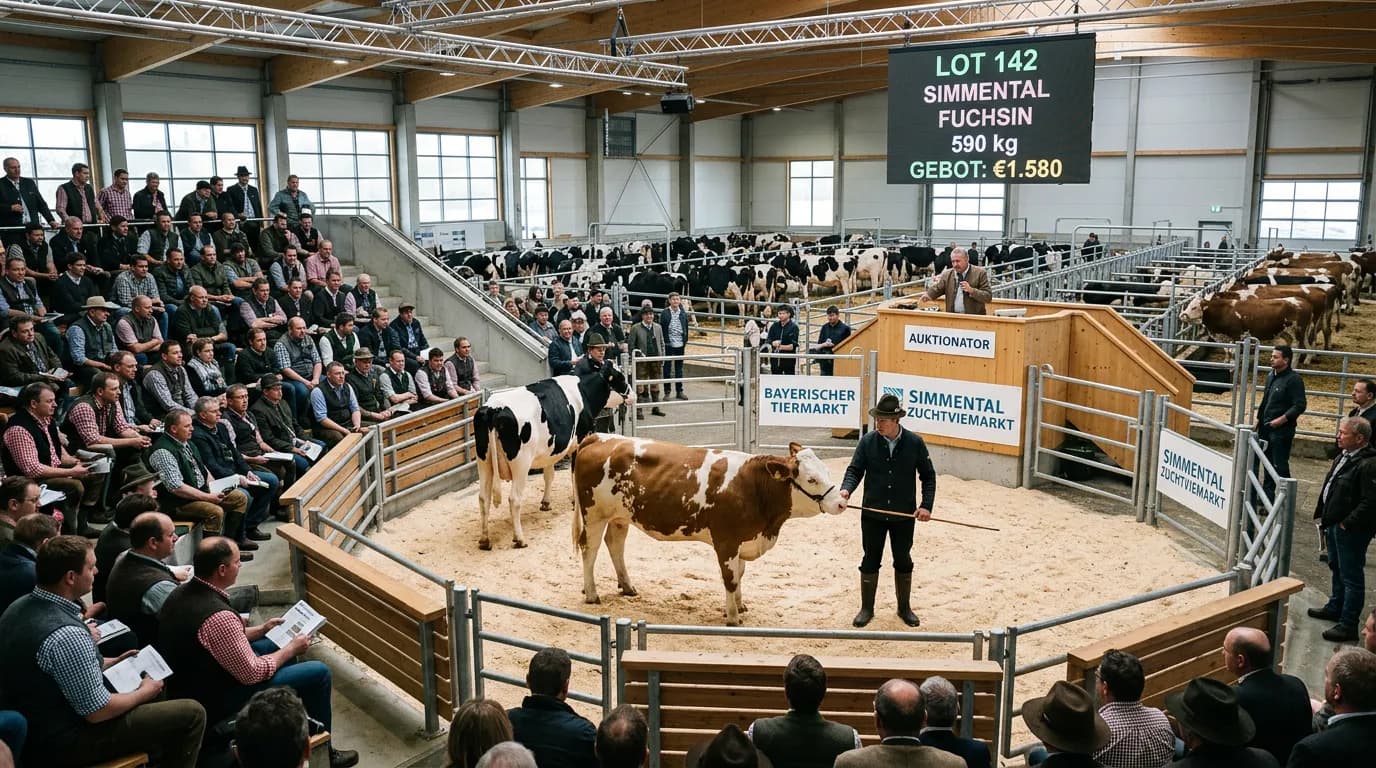
Livestock auctions (Viehauktionen or Nutzviehversteigerungen) are conducted by regional breeding associations (Zuchtverbände) and livestock marketing organizations. The largest and most important auction centers for Italian buyers include those in Bavaria (Miesbach, Traunstein, Rosenheim, Kempten), Baden-Württemberg (Herbertingen, Aulendorf), and Austria (Innsbruck, Salzburg, Lienz).
The Bavarian auction system is particularly well-organized. Auctions are held at regular intervals — typically weekly or bi-weekly — at dedicated auction facilities. Animals are presented in standardized categories based on breed, age, weight, and quality grade. Each animal is individually weighed, identified, and assessed by official graders before sale.
The auction process is typically conducted by a licensed auctioneer, with bidding in ascending price. Prices are quoted per kilogram of live weight or per head, depending on the category. Payment terms are usually settlement within 8–14 days through the auction house, which acts as intermediary between buyer and seller.
Auction catalogs are published in advance, allowing buyers to plan their attendance and identify lots of interest. Many auctions now offer online viewing and, in some cases, remote bidding options, though physical attendance remains the norm for export buyers.
Direct farm purchases are also possible in Germany, though less common than in France or Ireland. German farmers tend to prefer selling through auction houses or cooperative marketing channels, which provide price transparency and administrative convenience. However, larger breeders and specialized beef producers may sell directly to known buyers at negotiated prices.
Breeding associations also operate organized marketing programs that aggregate animals from member farms for sale to domestic and export buyers. These programs offer the advantage of quality assurance, health guarantees, and consolidated logistics.
Bovatra participates in key German and Austrian auctions and works with regional breeding associations to source cattle that meet Italian buyer specifications.
Regional Differences: Bavaria vs Northern Germany
Germany's cattle industry varies dramatically between its northern and southern regions, and understanding these differences is important for targeted sourcing.
Bavaria and the Alpine region (including the neighboring Austrian states of Tyrol, Salzburg, and Vorarlberg) is the heartland of Fleckvieh and Brown Swiss production. This region is characterized by smaller family farms (averaging 30–60 cattle), mountain and foothill pasture systems, strong breed identity and genetic programs, well-organized cooperative marketing structures, and proximity to the Italian border via the Brenner Pass.
For Italian buyers, Bavaria and Austria are the most relevant sourcing regions. The transport distance from Bavarian auction centers to northern Italian fattening operations is remarkably short — often only 4–8 hours via the Brenner motorway. This short distance minimizes transport stress and costs, making Alpine-origin cattle particularly attractive.
Northern Germany (Lower Saxony, Schleswig-Holstein, Mecklenburg-Vorpommern) is dominated by dairy production, primarily Holstein-Friesian. Farms in this region tend to be larger and more industrialized than in the south. For buyers seeking large numbers of Holstein bull calves or dairy-cross animals, northern Germany offers the highest volumes. However, the greater transport distance to Italy (12–18 hours) and the purely dairy-type genetics make this region less attractive for buyers seeking beef-type cattle.
Central Germany (Hesse, Thuringia, Saxony) has a mixed cattle industry with both dairy and beef elements. Some Fleckvieh are found in Franconia (northern Bavaria), and specialized beef herds using Angus, Limousin, and Charolais genetics are scattered throughout the region. While not a primary sourcing zone for Italian export buyers, this region can supplement procurement from the core Alpine areas.
When planning German sourcing, Italian buyers should focus their efforts on Bavaria and Austria for Fleckvieh and Brown Swiss, and consider northern Germany primarily for dairy-bred calves when volume and competitive pricing are the priority.
Quality Standards and Health Requirements
Germany maintains some of the strictest animal health and quality standards in Europe, which is both an advantage and a consideration for export buyers.
The German animal health status is excellent. Germany is officially free of brucellosis, bovine tuberculosis, and enzootic bovine leukosis. The country also has advanced BVD eradication programs, with many regions achieving BVD-free status. IBR (Infectious Bovine Rhinotracheitis) eradication is well advanced, with Bavaria and several other states maintaining IBR-free status under Article 10 of EU Regulation 2016/429. This high health status simplifies export procedures, as animals from disease-free regions require fewer pre-movement tests.
Animal identification in Germany is managed through the HI-Tier (Herkunftssicherungs- und Informationssystem für Tiere) national database. Every bovine animal is registered at birth with a unique identification number and two ear tags. All movements are recorded in real-time, providing complete traceability from birth. This system is fully compatible with EU TRACES requirements for intra-community trade.
Quality grading at German auctions follows standardized protocols. Animals are assessed for conformation, muscling, skeletal development, and overall condition. The official EUROP carcass classification is used as a reference for live animal grading, though specific auction houses may use additional proprietary grading criteria.
Animal welfare standards in Germany are among the highest in the EU, governed by the German Animal Welfare Act (Tierschutzgesetz) which in several areas exceeds EU minimum requirements. Farms, transport vehicles, and auction facilities are subject to regular inspection. For Italian buyers, this means that cattle purchased from Germany have been managed under consistently high welfare standards.
Veterinary documentation for export from Germany is straightforward given the country's disease-free status. The official veterinarian at the point of departure issues the required TRACES notification and health certificate. Pre-movement testing requirements are minimal for movements to Italy, typically limited to a clinical inspection and confirmation of disease-free herd status.
Bovatra ensures that all quality and health requirements are verified before purchase and that export documentation is prepared correctly and on schedule.
Export Documentation and Procedures
Exporting cattle from Germany to Italy follows EU intra-community trade regulations. Germany's efficient bureaucratic systems and high animal health status make the export process relatively straightforward.
The TRACES notification must be created by the official veterinarian in Germany before the animals depart. This electronic notification alerts the Italian competent authority of the incoming consignment and provides details of the animals, their origin, health status, and transport arrangements.
Health certificates accompany each consignment and confirm that the animals meet all EU health requirements for intra-community trade. Given Germany's disease-free status for brucellosis, TB, and leukosis, the certification process is streamlined — animals from certified disease-free herds in disease-free regions do not require individual pre-movement testing for these diseases.
Animal passports or movement documents must accompany all animals. Germany's HI-Tier system generates standardized documentation that is recognized across the EU. Each animal's identification, origin, and movement history are recorded electronically and can be verified through the database.
Transport documentation includes the carrier's EU transport authorization, driver certificates of competence, vehicle approval certificates, and a detailed journey log for trips exceeding 8 hours. German transport companies are well-versed in these requirements and maintain comprehensive documentation.
For Austrian cattle transiting through Austria to Italy via the Brenner Pass, the same EU intra-community trade rules apply. Austria is also an EU member state with excellent disease-free status, so no additional border procedures apply for the Austria-Italy segment.
Customs considerations are minimal for intra-EU trade. No customs declarations are required, and there are no duties or tariffs on livestock moving between Germany/Austria and Italy. VAT is handled under intra-community reverse charge rules.
Timeline planning is important. Buyers should allow at least 5–7 working days between final animal selection and planned loading date to ensure all veterinary inspections and documentation are completed. German veterinary services are efficient but operate on structured schedules that must be respected.
Bovatra coordinates all documentation and regulatory compliance for German and Austrian cattle exports, ensuring a smooth and timely process from auction purchase to delivery in Italy.
Transport Routes Through the Brenner Pass
The Brenner Pass is the primary transport corridor for cattle moving from Germany and Austria to Italy, and it represents one of the shortest and most efficient livestock transport routes in European trade.
The Brenner motorway (A13 in Austria, A22 in Italy) connects Innsbruck in Austria to Verona in northern Italy, crossing the Alpine watershed at the Brenner Pass at an elevation of 1,370 meters. The motorway section from the Brenner Pass to Verona is approximately 230 km and takes roughly 2.5–3 hours to drive.
From key Bavarian auction centers, the total transport distances and times to major Italian fattening regions are remarkably short. Munich to Verona is approximately 350 km (4–5 hours), Rosenheim to Bolzano is approximately 200 km (2.5–3 hours), Innsbruck to Verona is approximately 280 km (3–3.5 hours), and Kempten to Brescia is approximately 380 km (4.5–5.5 hours).
These short distances mean that most cattle shipments from Bavaria and Austria to northern Italy fall well within the 8-hour threshold that triggers additional transport requirements under EU Regulation 1/2005. This is a significant advantage over sourcing from France or Ireland, where journeys of 12–20+ hours are typical.
The Brenner Pass route does involve mountain driving, including significant altitude changes and potentially challenging winter conditions. Licensed livestock transport operators on this route use specialized vehicles appropriate for Alpine conditions and are experienced in managing the gradient and weather challenges.
Tirol in Austria has specific transit regulations for heavy goods vehicles, including driving bans on certain days and hours and sector restrictions. Livestock transport vehicles are generally exempt from the most restrictive bans, but transit scheduling must account for these regulations to avoid delays.
Alternative routes to the Brenner include the Reschen Pass (connecting Tyrol to South Tyrol/Vinschgau), the Tauern motorway through Salzburg to Villach and then via Tarvisio into Friuli Venezia Giulia, and the route through Switzerland via the Gotthard or San Bernardino passes (though Swiss transit adds complexity and transit fees).
Transport costs from Bavaria to northern Italy are among the lowest in European livestock trade, typically ranging from EUR 40–80 per head for full truckloads. This cost advantage is a major factor in the competitiveness of German and Austrian cattle for the Italian market.
Bovatra works with experienced Alpine transport operators to ensure efficient, welfare-compliant delivery from German and Austrian auction centers to Italian destinations.
Pricing and Market Dynamics
German and Austrian cattle pricing reflects the high quality standards and strong genetic base of the Alpine cattle population, but also the efficient production systems and competitive market structures in these countries.
Fleckvieh cattle prices at Bavarian auctions vary by age, weight, sex, and quality grade. As a general guide, Fleckvieh calves (80–150 kg) trade at EUR 4.00–6.50 per kg live weight, Fleckvieh store cattle (250–400 kg) trade at EUR 2.80–3.80 per kg, and Fleckvieh young bulls (400–550 kg) trade at EUR 2.50–3.30 per kg. Austrian prices tend to be similar, though seasonal and regional variations exist.
Holstein bull calves from northern Germany are significantly cheaper, typically trading at EUR 1.50–3.00 per kg for 14-day-old calves (45–60 kg) or EUR 50–180 per head depending on weight and market conditions.
Price trends in the German market are influenced by domestic dairy economics (milk prices affect calf availability and pricing), EU-wide beef market conditions, feed costs (Germany is a major cereal producer), Italian and Spanish buyer demand (the two primary export markets), and seasonal calving patterns.
The total landed cost for German/Austrian cattle delivered to northern Italy is typically among the most competitive in European trade, thanks to the short transport distances. Additional costs above the auction purchase price typically include auction commission (2–3%), veterinary certification (EUR 10–20 per head), transport to Italy (EUR 40–80 per head), and agent fees if applicable (1–3%).
Total additional costs of EUR 70–150 per head above the auction price make German/Austrian sourcing cost-efficient, particularly for Fleckvieh cattle that would command premium prices if sourced from more distant origins.
Bovatra provides current pricing intelligence from German and Austrian auctions and helps buyers develop procurement strategies that capture the best value from this market.
Why Source Cattle from Germany Through Bovatra
Germany and Austria represent an essential sourcing origin for Italian fattening operations, particularly for buyers seeking Simmental/Fleckvieh and Brown Swiss cattle. The combination of world-class genetics, excellent animal health status, transparent auction systems, and the shortest transport routes to northern Italy via the Brenner Pass creates a compelling value proposition.
The key advantages of German and Austrian sourcing include access to the world's largest Fleckvieh population with advanced genetic programs, exceptional animal health status (disease-free for TB, brucellosis, and leukosis), transparent and well-organized auction markets with standardized quality grading, the shortest transport distances to Italian fattening regions (often under 8 hours), lowest transport costs per head in European livestock trade, and efficient export documentation thanks to high health status and modern administrative systems.
Challenges to be managed include the German auction system's specific operating procedures and schedules, competition from other export buyers (particularly from Spain and Turkey), seasonal availability fluctuations, and language barriers for buyers not familiar with German-language auction processes.
Bovatra provides the expertise and market access needed to source effectively from Germany and Austria. Our presence at key Bavarian and Austrian auctions, combined with relationships with regional breeding associations and transport operators, ensures that Italian buyers can access the full range of German and Austrian cattle at competitive prices.
Whether you need Fleckvieh store cattle from Bavaria, Holstein bull calves from northern Germany, or Brown Swiss from the Austrian Alps, Bovatra delivers quality cattle with full documentation, efficient transport, and transparent pricing.
Contact Bovatra to discuss how German and Austrian cattle can strengthen your procurement program and improve your fattening operation's performance.
Source Cattle from Germany
Related Guides
Simmental (Fleckvieh) Cattle Guide: Dual-Purpose Breed Profile
A comprehensive guide to Simmental (Fleckvieh) cattle for professional buyers — dual-purpose breed traits, fattening performance, German and Austrian sourcing, and transport logistics to Italy.
Holstein-Friesian Cattle Guide: Characteristics & Market Uses
A comprehensive guide to Holstein-Friesian cattle for professional buyers — covering dairy and beef market roles, male calf utilization, sourcing from Germany, and mixed-market procurement strategies.
Buying Cattle From France: Breeds, Markets & Export Process
A comprehensive guide to sourcing cattle from France for European buyers — covering available breeds, livestock markets, seasonal patterns, export documentation, and transport logistics.
Ready to Source Livestock — or List Your Stock?
Whether you are a buyer looking for specific breeds or a seller seeking reliable access to European buyers, Bovatra manages the full transaction cycle.