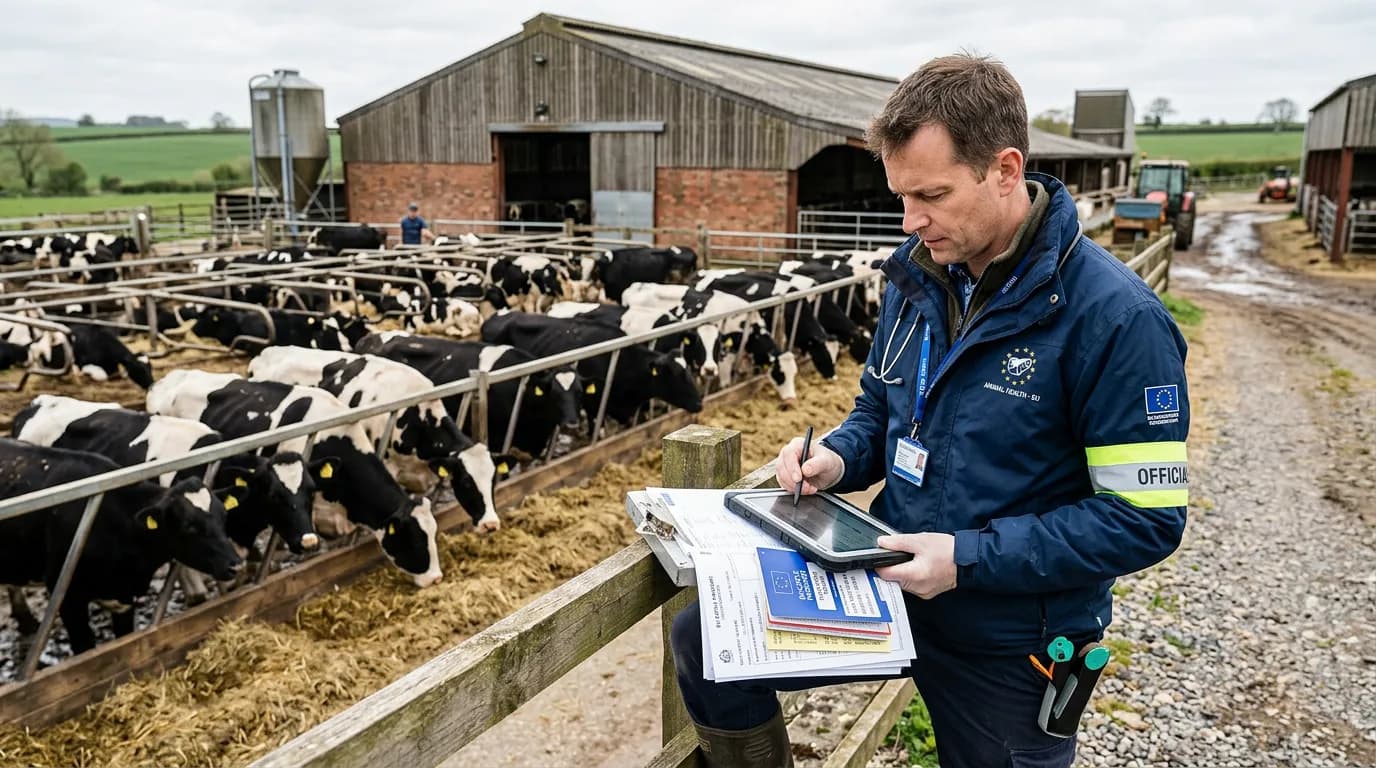
TRACES System Guide: EU Livestock Trade Documentation Explained
A comprehensive guide to the EU TRACES platform — how it works, who needs to use it, notification types, and how Bovatra manages documentation for seamless cross-border cattle trade.
Table of Contents
What is the TRACES System?
TRACES — the Trade Control and Expert System — is the European Commission's centralised online platform for managing sanitary and phytosanitary certificates required for the trade and import of animals, animal products, food, feed, and plants across EU borders. Launched in its original form in 2003 and significantly upgraded through its integration into the IMSOC (Information Management System for Official Controls) framework in December 2019, TRACES is now the mandatory digital backbone of all intra-EU livestock movements and third-country imports into the EU.
For anyone involved in the cross-border cattle trade — whether as a buyer, seller, transporter, or veterinary authority — understanding the TRACES system is not optional. Every consignment of live cattle moving between EU Member States must be notified through TRACES before departure, and the system generates the electronic health certificates and movement documents that accompany animals throughout their journey. Without a properly completed TRACES notification, cattle cannot legally cross an EU internal border.
The system serves multiple purposes simultaneously: it provides traceability of animal movements across the EU, enables veterinary authorities in both origin and destination countries to monitor and control livestock movements in real time, facilitates the rapid exchange of information in the event of a disease outbreak, and creates an auditable record of compliance with EU animal health and welfare legislation. For professional livestock traders, TRACES is the single most important documentation system in their daily operations.
TRACES and IMSOC Integration
Since December 2019, TRACES has operated as a core module within the broader IMSOC framework, which was established under Regulation (EU) 2017/625 — the Official Controls Regulation. IMSOC integrates three previously separate systems into a unified platform: TRACES (for trade and import notifications), RASFF (the Rapid Alert System for Food and Feed), and AAC (Administrative Assistance and Cooperation).
This integration means that TRACES now functions as part of a comprehensive surveillance and control ecosystem. When a veterinary authority in Italy identifies a health concern with an incoming consignment of cattle from France, that information can be shared instantly with French authorities, the European Commission, and other Member States through the interconnected IMSOC modules. This real-time information exchange has dramatically improved the EU's ability to respond to animal health emergencies and has made fraudulent documentation significantly more difficult.
For practical purposes, livestock traders interact primarily with the TRACES module of IMSOC. The system is accessed through a web-based interface at the European Commission's TRACES portal. All operators who participate in intra-community trade must be registered in the system with a unique operator identification number linked to their business registration and, where applicable, their approved establishment number. Registration is managed through the competent authority in the operator's Member State — in Italy, this is the local ASL veterinary service (Azienda Sanitaria Locale).
The IMSOC integration also introduced enhanced data analytics capabilities. Competent authorities can now use the system to identify patterns, assess risk profiles, and target official controls more effectively. For compliant operators, this data-driven approach to enforcement should, over time, reduce the administrative burden by focusing inspections where risk is highest.
Who Needs to Use TRACES?
The obligation to use TRACES extends to all parties involved in the chain of intra-community livestock trade. Understanding who is responsible for what within the system is essential for ensuring smooth and compliant transactions.
The consignor (exporter/seller) initiates the process by arranging for a TRACES notification to be created for each consignment. In practice, this often means the consignor's official veterinarian or an authorized agent creates the initial notification in the system with details of the animals to be dispatched, the consignee, the transport route, and the expected departure date.
The official veterinarian (OV) in the country of origin plays a critical role. The OV is responsible for clinically inspecting the animals, verifying their health status against EU requirements, confirming their identification (ear tags, passports), and certifying the TRACES notification. Without the OV's electronic signature, the notification is not valid and the animals cannot be dispatched. The OV must complete certification within 24 hours of the planned departure time.
The transporter must be registered in TRACES and must hold a valid transporter authorization in accordance with Regulation (EC) No 1/2005 on animal welfare during transport. The transporter's details are included in the TRACES notification, and the journey log — required for journeys exceeding 8 hours — is linked to the notification.
The consignee (importer/buyer) in the destination country must also be registered in TRACES. Upon arrival of the animals, the destination competent authority is automatically notified through the system and is responsible for conducting any required arrival checks. The consignee must ensure that animals arriving at their premises are accompanied by a valid TRACES notification and that the destination authority is informed of arrival.
Bovatra acts as an authorized intermediary in the TRACES process, managing the documentation workflow between all parties — from initiating notifications with origin veterinarians to coordinating with destination ASL authorities in Italy.
Types of TRACES Notifications
TRACES handles several distinct types of notifications, each corresponding to a different type of trade or movement. For livestock traders, three notification types are particularly relevant.
INTRA certificates are used for intra-community trade — that is, movements of live animals between EU Member States. This is the most common notification type for cattle traded between France, Ireland, Germany, and Italy. The INTRA certificate replaces the former paper-based intra-community health certificate and contains all the health, identification, and transport information required under EU legislation. Each INTRA notification is assigned a unique reference number that serves as the primary identifier for the consignment throughout its journey.
DOCOM (Document of Commerce) notifications are used for movements of animal by-products and certain processed products within the EU. While less directly relevant to live cattle trade, traders who also deal in genetics (semen, embryos) or who manage by-products from their operations may encounter DOCOM requirements.
CVED (Common Veterinary Entry Document) notifications — now referred to as CHED (Common Health Entry Document) under the IMSOC framework — are used for imports of live animals from third countries (non-EU countries) into the EU. These are relevant for traders importing cattle from the United Kingdom post-Brexit, or from other non-EU countries. CHED notifications are processed at designated Border Control Posts (BCPs), where physical, identity, and documentary checks are performed before animals are allowed to enter the EU.
For the typical France-to-Italy or Ireland-to-Italy cattle trade that forms the core of Bovatra's operations, the INTRA notification is the relevant document type. Each INTRA notification covers a single consignment from a single origin to a single destination, though a consignment may include multiple animals from the same holding.
Step-by-Step TRACES Process for Cattle Trade
The TRACES process for a typical intra-community cattle consignment follows a structured sequence of steps, each involving specific parties and timelines.
Step 1 — Notification creation: The consignor or their authorized agent creates a new INTRA notification in TRACES. This includes entering the details of the consignor and their holding, the consignee and their destination holding, the animals (species, breed, identification numbers, age, sex), the intended transport route, the transporter, and the expected departure date. The notification must be created far enough in advance to allow the official veterinarian to schedule the pre-departure inspection.
Step 2 — Veterinary inspection and certification: The official veterinarian at the origin holding inspects the animals within 24 hours of the scheduled departure. The inspection confirms that animals are clinically healthy, properly identified, meet all EU health requirements (testing for TB, brucellosis, etc.), and are fit for transport. If satisfied, the OV electronically signs and certifies the INTRA notification in TRACES. At this point, the notification becomes a valid health certificate.
Step 3 — Dispatch notification: Once certified, the TRACES system automatically notifies the competent authority in the destination Member State. This advance notification allows the destination authority to plan any arrival inspections and verify the receiving holding's registration and capacity.
Step 4 — Transport: The animals are transported in accordance with the details specified in the TRACES notification. The certified INTRA notification (or a printout) must accompany the animals during transport. The transporter's journey log, if required, is linked to the TRACES reference number.
Step 5 — Arrival and confirmation: Upon arrival at the destination holding, the competent authority in the destination country acknowledges receipt of the consignment in TRACES. This closes the notification loop and confirms that the animals have arrived at the declared destination. In Italy, the local ASL is responsible for this confirmation step and may conduct physical checks on arriving animals.
Step 6 — Archiving: The completed notification is archived in TRACES and remains accessible for audit and traceability purposes. Authorities can retrieve historical notifications to trace animal movements in the event of a disease investigation.
Key Information Required in a TRACES Notification
A TRACES INTRA notification for live cattle requires comprehensive and accurate information across several categories. Errors or omissions at this stage are the most common cause of delays and rejections, so attention to detail is critical.
Animal identification data includes individual ear tag numbers (both primary and secondary tags as required under Regulation (EC) No 1760/2000), the species and breed, date of birth, sex, and the cattle passport number. For consignments involving multiple animals, each animal must be individually listed with its unique identification. The TRACES system cross-references this information against national cattle identification databases, so any discrepancy between the notification and the animal's registered data will flag an error.
Holding information requires the complete registration details of both the origin and destination holdings, including the holding registration number, address, and the name of the responsible person. The origin holding must be under official veterinary supervision and must not be under any movement restrictions at the time of dispatch.
Health status data includes the results of any required tests (tuberculin testing, brucellosis serology, leukosis testing, BVD status), vaccination records, and confirmation that the animals have been resident on the holding of origin for the required minimum period (typically 30 days for cattle in intra-community trade). The health attestations that the OV certifies are drawn directly from the harmonized EU health requirements laid down in the Animal Health Law (Regulation (EU) 2016/429) and its delegated and implementing acts.
Transport details encompass the transporter's name, authorization number, vehicle registration, the planned route including any rest stops or transfer points, the estimated departure and arrival times, and the journey log reference for journeys exceeding 8 hours. The total journey time must comply with the maximum duration limits set out in Regulation (EC) No 1/2005.
Common Pitfalls and Rejection Reasons
Despite the system's structured nature, TRACES notifications are frequently rejected or delayed due to recurring errors. Understanding these common pitfalls helps traders avoid costly disruptions.
Incorrect or mismatched animal identification is the most frequent cause of rejection. If the ear tag numbers entered in TRACES do not match the animals presented for inspection, or if there are discrepancies with the national cattle database, the official veterinarian cannot certify the notification. This often occurs when replacement tags have been applied without updating the national database, or when transcription errors occur during data entry.
Expired or incomplete health testing is another major issue. Each EU Member State has specific testing protocols, and the validity periods of test results are strictly defined. For example, a tuberculin test for intra-community trade is typically valid for 30 days from the date the test is read. If the animals are not dispatched within this window, new testing is required. Traders who fail to plan their testing schedule around realistic dispatch dates frequently encounter this problem.
Insufficient residency period on the holding of origin can also block certification. EU rules generally require that cattle have been resident on the origin holding for at least 30 days before dispatch, or since birth if younger than 30 days. Animals that have been recently purchased and moved to a collection center may not meet this requirement unless the center is specifically approved for assembly purposes.
Transporter authorization issues arise when the transporter's details in TRACES are incorrect, their authorization has expired, or the vehicle does not meet the required standards. Since the transporter is certified as part of the INTRA notification, any issue with the transporter's credentials blocks the entire notification.
Late notification or insufficient lead time for the official veterinarian is a practical but common problem. OVs operate on scheduled appointment systems, and last-minute requests for certification may not be accommodated. In some regions of France, particularly during peak broutard season, OV availability is limited, and advance booking of 5-7 days is advisable.
Bovatra's documentation team systematically reviews every TRACES notification before submission, cross-checking animal identification against database records, verifying test validity dates, confirming transporter credentials, and coordinating with OVs to ensure timely certification.
TRACES and the Animal Health Law
The EU Animal Health Law (Regulation (EU) 2016/429), which came into full application on 21 April 2021, significantly reformed the legislative framework governing animal health in the EU. TRACES has been updated to align with the new requirements introduced by the Animal Health Law and its numerous delegated and implementing regulations.
Under the Animal Health Law, the health requirements for intra-community movement of cattle are defined more precisely and are structured around the categorization of diseases by severity and trade impact. Category A diseases (such as rinderpest) require eradication measures, while Category B-E diseases have varying control and monitoring requirements that affect trade eligibility. The TRACES system now reflects these categorizations, and the health attestations in INTRA notifications are aligned with the disease-specific requirements of the Animal Health Law.
One significant change under the Animal Health Law is the enhanced emphasis on establishment registration and approval. All holdings from which cattle are dispatched for intra-community trade must be registered with the competent authority, and certain operations (such as assembly centers and confined establishments) require specific approval. TRACES validates holding registration as part of the notification process.
The Animal Health Law also introduced stricter requirements for operator responsibility. Operators are now explicitly required to implement biosecurity measures, maintain accurate records of animal movements and health events, and cooperate with official controls. TRACES supports this framework by providing a transparent and auditable record of all movements.
For traders, the practical impact of the Animal Health Law on TRACES usage is primarily felt through updated health attestation requirements, more detailed documentation of disease testing and surveillance, and enhanced requirements for holding registration. Bovatra stays current with all regulatory updates to ensure that the documentation we prepare for clients is fully compliant with the latest requirements.
Digital Features and System Access
TRACES NT (New Technology), the current generation of the platform, offers several features designed to improve usability and efficiency for regular users.
The system's web-based interface is accessible from any modern browser without the need for specialized software. Users log in through the EU Login authentication system (formerly ECAS) with a unique personal account. Access permissions are role-based: operators can create and submit notifications, official veterinarians can certify notifications, and competent authorities have broader supervisory and control functions.
Template functionality allows regular users to save notification templates based on frequently used consignment configurations. For a trader who regularly ships Charolais broutards from a specific region in France to a regular buyer in the Veneto, templates can pre-populate holding details, transport routes, and other recurring data fields, significantly reducing data entry time and the risk of transcription errors.
The notification tracking feature provides real-time visibility into the status of each notification through its lifecycle — from draft, to submitted, to certified, to received at destination. This tracking is invaluable for traders managing multiple concurrent consignments and for coordinating with transport companies and buyers.
Automated alerts and notifications are sent to relevant parties at key stages of the process. The destination competent authority receives advance notification of incoming consignments, while the consignor is notified when the OV has certified the notification and when the destination authority has confirmed arrival.
Reporting and data export functions allow operators and authorities to extract historical data for analysis, compliance reporting, and business planning. Traders can review their consignment history, analyze seasonal patterns, and generate documentation for audit purposes.
Mobile access has improved in recent iterations of the platform, though the full functionality of TRACES is best accessed via a desktop browser. The European Commission continues to invest in usability improvements, and updates to the platform are released periodically.
How Bovatra Manages TRACES for Clients
Navigating the TRACES system efficiently requires expertise, attention to detail, and established relationships with veterinary authorities in both origin and destination countries. For professional livestock buyers, the administrative burden of managing TRACES documentation can be significant — particularly when dealing with multiple consignments from different origins on tight timelines.
Bovatra provides comprehensive TRACES documentation management as an integrated part of every livestock transaction. Our approach covers the entire documentation lifecycle from pre-notification through to destination confirmation.
Before any animals are selected for a consignment, our documentation team verifies the holding registration status, checks the disease status of the origin region and holding, confirms the testing requirements applicable to the specific trade route, and coordinates with the origin official veterinarian to schedule inspections and certification.
During the notification phase, we prepare the TRACES INTRA notification with verified animal identification data, cross-check all details against national database records, ensure that health test results are within their validity periods, and submit the notification for OV certification with adequate lead time. Our team monitors the notification status in real time and addresses any queries or corrections requested by the certifying veterinarian promptly.
For the transport phase, we verify the transporter's TRACES registration and authorization status, ensure that journey logs are correctly linked to the TRACES notification, and coordinate departure timing to align with the certification validity window. Upon arrival in Italy, we liaise with the destination ASL to ensure timely confirmation of the consignment in TRACES, minimizing any holding period at the destination before animals can enter normal management.
This end-to-end documentation service eliminates the most common causes of delays and rejections in cross-border cattle trade, allowing our clients to focus on their core business of livestock management and production. Contact Bovatra to discuss your documentation requirements and learn how we can streamline your cross-border cattle procurement.
Discuss Documentation Requirements
Related Guides
EU Livestock Transport Regulations: Complete Guide to Regulation 1/2005
A comprehensive guide to EU Council Regulation (EC) No 1/2005 on the protection of animals during transport — covering journey time limits, vehicle standards, documentation requirements, and practical implications for cross-border cattle trade.
Livestock Health Certificates in the EU: Requirements & Process
A detailed guide to EU health certificate requirements for intra-community cattle trade — covering veterinary inspections, disease testing, quarantine periods, and common rejection reasons.
How to Import Livestock to Italy: Complete Buyer's Guide
A step-by-step guide to importing cattle into Italy — covering legal requirements, TRACES notifications, health certificates, border inspections, ASL procedures, and common mistakes to avoid.
Ready to Source Livestock — or List Your Stock?
Whether you are a buyer looking for specific breeds or a seller seeking reliable access to European buyers, Bovatra manages the full transaction cycle.