Buying Cattle From Ireland: Angus, Hereford & Export Guide
A detailed guide to sourcing cattle from Ireland — covering grass-based production, key breeds, purchasing through marts, quality assurance, export logistics, and transport to Italy.
Table of Contents
Ireland's Grass-Based Production Advantage
Ireland occupies a unique position in European livestock production. Its temperate maritime climate, with mild winters and abundant rainfall, produces some of the richest natural grasslands in the world. Approximately 80% of Irish agricultural land is devoted to grass, and cattle spend an average of 220–250 days per year at pasture — significantly more than in any other major European cattle-producing country.
This grass-based production system gives Irish cattle several distinct advantages. Animals develop strong skeletal frames and robust constitutions from outdoor rearing, which translates into resilience during transport and adaptation to new environments. The extended grazing period means lower production costs compared to housed systems, which is reflected in competitive pricing for Irish store cattle and weanlings.
Ireland's national cattle herd stands at approximately 7.3 million head, including 1 million suckler cows and a large dairy herd of over 1.5 million cows. The country produces significantly more cattle than it can finish domestically, creating a structural export surplus that makes Ireland one of Europe's most important sources of live cattle for fattening operations elsewhere on the continent.
For Italian buyers, Irish cattle offer an attractive combination of competitive pricing, robust animal health, and breeds well-suited to both intensive and semi-intensive finishing systems. While Ireland is not as dominant in the Italian import market as France, it represents an increasingly important diversification option for professional buyers seeking alternative sourcing channels.
Key Breeds Available from Ireland
Ireland produces a diverse range of cattle breeds and crosses, reflecting both its strong tradition in British beef breeds and the growing influence of Continental genetics introduced over the past four decades.
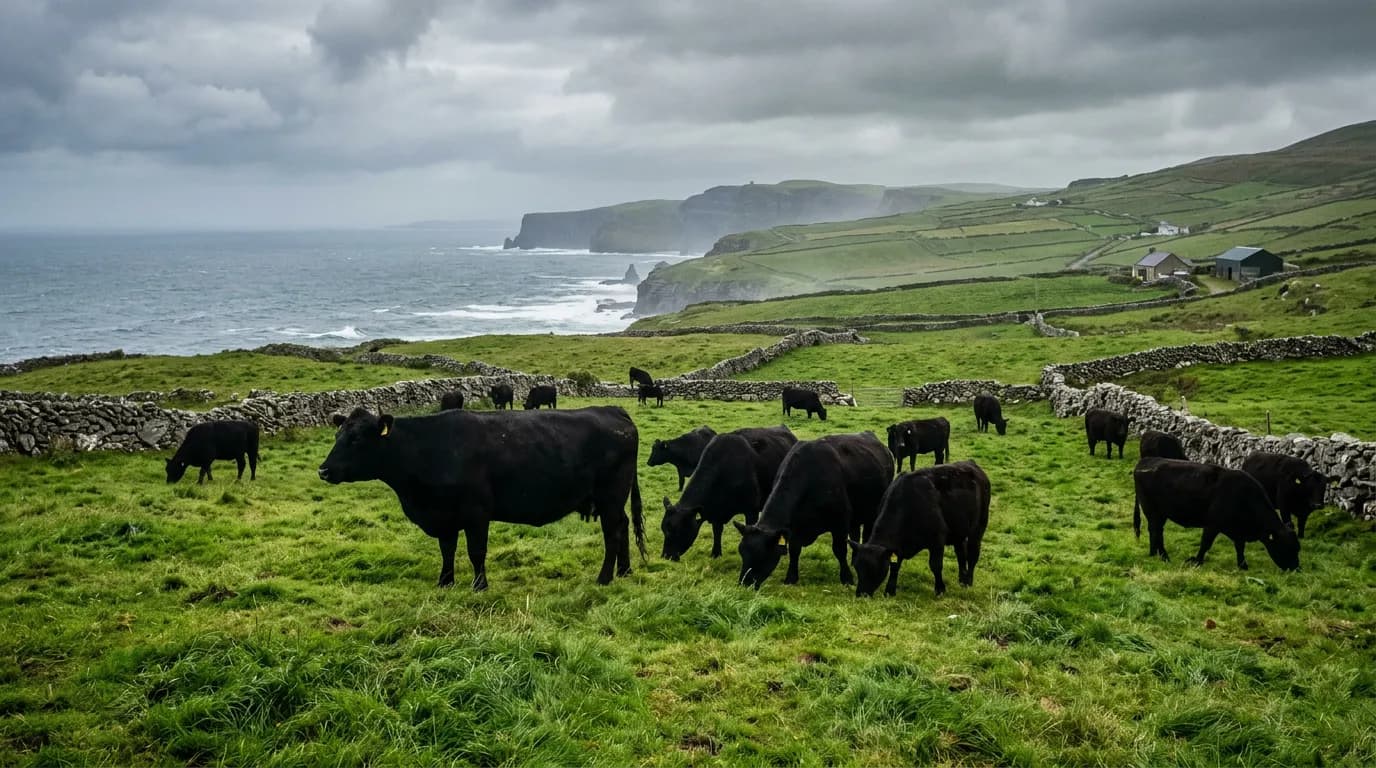
Aberdeen Angus is one of Ireland's signature beef breeds. Irish Angus cattle are known for their early maturity, excellent marbling, and adaptability to various finishing systems. They typically reach finishing weights of 550–650 kg at 16–20 months, with carcass weights of 300–370 kg. Angus cattle are particularly valued for premium beef programs and branded product lines across Europe.
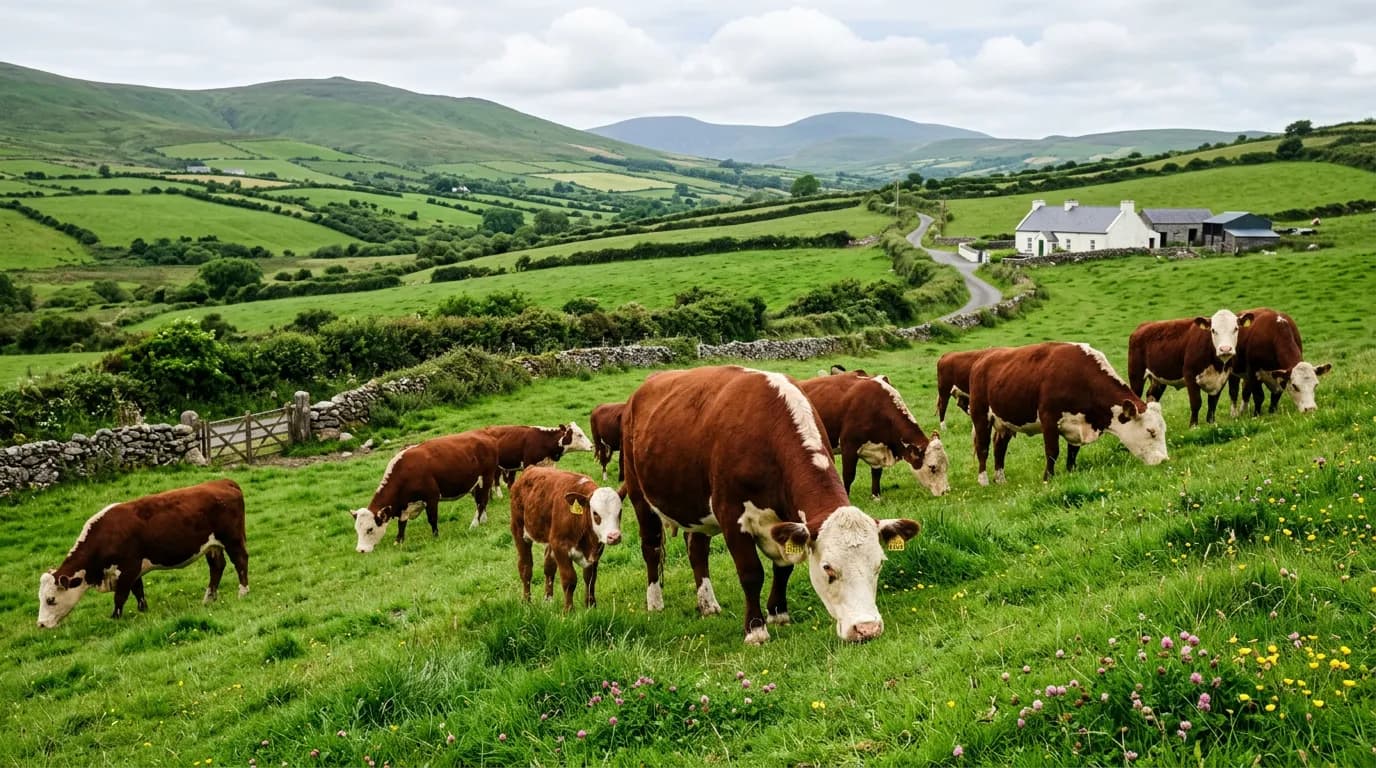
Hereford cattle have a long heritage in Ireland and remain popular in suckler herds, particularly in the western counties. Irish Herefords are medium-framed, easy-finishing animals with good temperaments and consistent carcass quality. They perform well in both grass-based and concentrate-supplemented finishing systems, typically reaching slaughter weights of 550–630 kg.
Continental crosses represent a growing share of Irish cattle exports. Charolais-cross, Limousin-cross, and Simmental-cross cattle bred from both suckler and dairy cows are widely available. These crosses combine the growth potential and muscling of Continental breeds with the hardiness and adaptability developed in the Irish production environment. Charolais-cross weanlings from Irish suckler herds are particularly sought after by Italian buyers for their balance of growth rate and feed efficiency.
Dairy-bred cattle — primarily Holstein-Friesian and their crosses — are available in large numbers from Ireland's expanding dairy sector. While these animals have lower carcass yields than pure beef breeds, they offer competitive pricing and can be profitably finished in Italian systems that target the processing beef market rather than premium retail channels.
Belgian Blue crosses have also gained popularity in Ireland, offering exceptional muscular development and high killing-out percentages. However, their availability is more limited compared to Angus, Hereford, and Continental crosses.
Purchasing Through Marts and Direct Sales
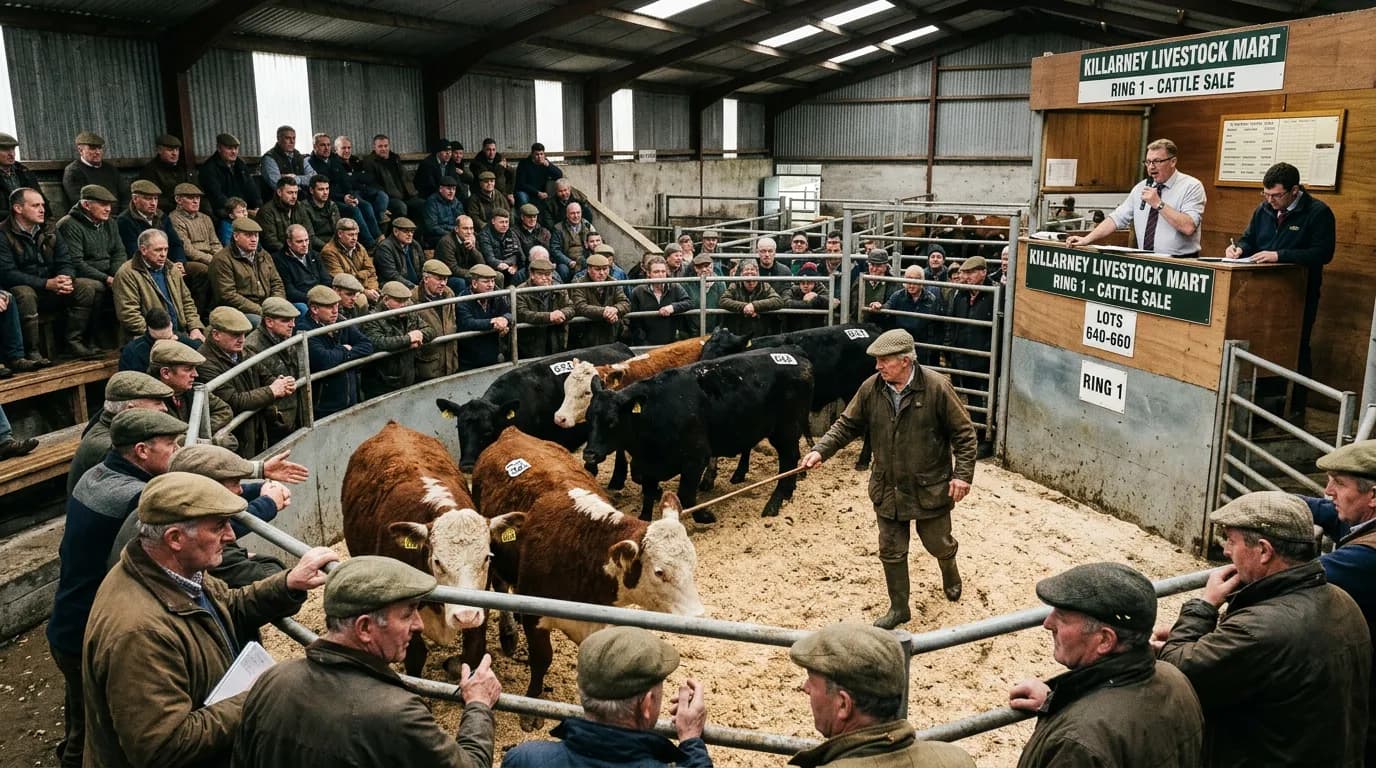
The Irish livestock marketing system is centered on a well-developed network of livestock marts (auction markets) that operates across the country. Understanding how this system works is essential for effective procurement.
Ireland has approximately 60 active livestock marts, regulated by the Department of Agriculture, Food and the Marine (DAFM). Major marts for beef cattle include those at Ballinasloe, Tullamore, Ennis, Kilkenny, Roscommon, and Castlerea. Each mart operates on a regular weekly schedule, with dedicated sale days for different categories of cattle — weanlings, store cattle, finished cattle, and breeding stock.
The mart system offers several advantages for buyers: transparent price discovery through open auction, the ability to visually inspect and select animals, access to large numbers of cattle from multiple farms in one location, and regulated weighing and identification procedures. Most marts now use electronic identification scanning and provide live-weight data for all animals sold.
Weanling sales are concentrated in the autumn months (September–November), when spring-born calves are typically sold at 7–10 months of age and weighing 250–400 kg depending on breed and sex. These sales attract significant international buying interest and represent the primary purchasing window for export buyers.
Direct farm purchases are an alternative channel, particularly for larger volume buyers seeking specific breed types or weight specifications. Many Irish farmers are willing to sell directly to known buyers or through established agents, often at negotiated prices that may offer slight discounts compared to mart prices in exchange for the convenience of farm-gate collection.
Online marketing platforms are an emerging channel in Ireland. Platforms such as MartEye and LSL Auctions provide online bidding alongside traditional in-ring sales, allowing remote buyers to participate in mart auctions. While online purchasing can expand access, most Italian export buyers still prefer physical inspection through local agents or personal mart attendance.
Bovatra works with experienced Irish agents and attends key marts throughout the buying season to source cattle that meet Italian buyer specifications.
Bord Bia Quality Assurance
Ireland's national food quality assurance program, operated by Bord Bia (the Irish Food Board), is one of the most comprehensive farm-to-fork quality systems in Europe. Understanding this system is relevant for Italian buyers because it provides a reliable baseline of production standards for Irish cattle.
The Bord Bia Sustainable Beef and Lamb Assurance Scheme (SBLAS) covers approximately 53,000 beef farms in Ireland — representing the vast majority of commercial producers. Certified farms must comply with detailed standards covering animal welfare, traceability, feed safety, environmental management, and veterinary medicine use.
Key elements of the scheme include full birth-to-slaughter traceability through Ireland's national cattle identification system (AIM — Animal Identification and Movement), on-farm audits conducted by independent auditors every 18 months, restrictions on the use of growth-promoting substances (which are prohibited across the EU), documented animal welfare standards for housing, handling, and transport, and environmental sustainability metrics including carbon footprint assessment.
For Italian buyers, purchasing cattle from Bord Bia-certified farms provides assurance of production standards that meet or exceed EU baseline requirements. While Bord Bia certification is primarily a market-access tool for Irish beef exports to retail customers, the underlying farm standards also benefit live export buyers by ensuring that animals have been managed to consistent welfare and health standards.
Ireland's animal identification and traceability system is particularly robust. Every bovine animal born in Ireland receives a unique identification number, an individual passport, and two ear tags within 20 days of birth. All movements between holdings are recorded in the national database, creating a complete movement history for every animal. This traceability infrastructure gives Italian buyers confidence in the origin and health history of purchased animals.
Export Procedures and Post-Brexit Considerations
Exporting cattle from the Republic of Ireland to Italy follows standard EU intra-community trade procedures, as both countries are EU member states. However, the situation regarding Northern Ireland introduces additional complexity that buyers should understand.
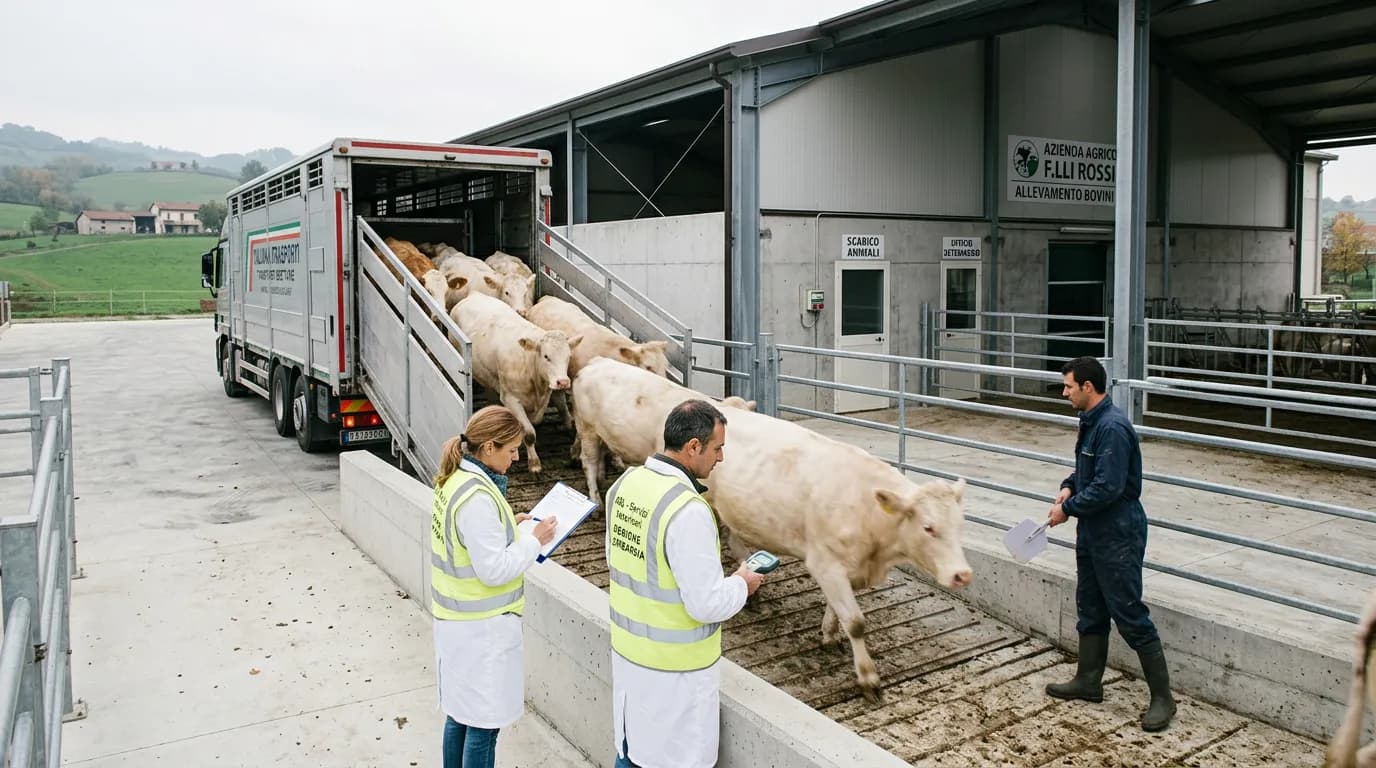
For cattle exported from the Republic of Ireland, the process mirrors that of any EU-to-EU livestock movement. The key requirements include TRACES notification created by the exporting veterinarian, health certificates issued within 24 hours of loading, compliance with destination country health requirements (tuberculosis, brucellosis, and leukosis testing), approved transport arrangements with licensed carriers, and journey logs for trips exceeding 8 hours.
Ireland's specific disease status adds certain requirements. Ireland has been officially free of brucellosis since 2009 and maintains an approved bovine tuberculosis eradication program. However, TB testing requirements for export may vary depending on the destination member state's own health status and requirements. Italian authorities may require additional testing beyond the standard pre-movement TB test conducted in Ireland.
Northern Ireland presents a unique situation following Brexit. Under the Windsor Framework (which replaced the original Northern Ireland Protocol), Northern Ireland remains aligned with EU single market rules for goods, including live animals. This means that cattle from Northern Ireland can still be traded into the EU single market, including Italy, under EU intra-community trade rules rather than third-country import procedures.
However, the practical implementation of these arrangements can involve additional administrative steps. Buyers sourcing cattle that have spent time in both Northern Ireland and the Republic of Ireland should ensure that the complete movement history is documented and that all EU health requirements are met, regardless of which jurisdiction the animals originated in.
Bovatra maintains current knowledge of all export requirements for both the Republic of Ireland and Northern Ireland, ensuring that documentation is complete and compliant for every shipment to Italy.
Transport Logistics: Sea and Road
Transporting cattle from Ireland to Italy involves a combined sea and road journey that requires careful planning to ensure animal welfare and regulatory compliance.
The first leg of the journey is the sea crossing from Ireland to continental Europe. The primary routes are from Dublin or Rosslare to Cherbourg or Roscoff in France (approximately 18 hours), or from Dublin/Rosslare to continental ports via the UK landbridge — though the latter has become less attractive post-Brexit due to additional border controls. Direct ferry services from Ireland to France have expanded significantly since 2021, with multiple operators offering regular roll-on/roll-off sailings suitable for livestock transport vehicles.
Animals must be fit for sea transport, and specific loading and care requirements apply during the crossing. EU regulations require that animals have adequate space, access to water, and appropriate ventilation during sea transport. Livestock vessels and livestock-carrying areas on ro-ro ferries must meet defined standards for animal welfare.
After disembarkation in France, the road journey to Italy follows the established transport routes through France and across the Alps. The total road distance from Cherbourg to northern Italy is approximately 1,300–1,500 km, requiring 15–20 hours of driving time. Combined with the sea crossing, the total journey time from farm in Ireland to destination in Italy can range from 36 to 55 hours depending on the specific route and connections.
For journeys of this duration, EU Regulation 1/2005 requires mandatory rest periods. After 29 hours of travel (including 14 hours of road transport), cattle must be rested for at least 24 hours at an approved control post with feed, water, and bedding facilities. Several approved control posts in France are regularly used for Irish cattle in transit to Italy.
Transport costs from Ireland to Italy are typically higher than from France due to the additional sea crossing, generally ranging from EUR 150–250 per head depending on lot size, route, and season. Despite the higher transport costs, the competitive pricing of Irish cattle at origin can still make this a viable sourcing option, particularly for breeds and crosses that are not as readily available from France.
Bovatra coordinates the complete transport chain from farm collection in Ireland through sea crossing, road transport, and delivery to the buyer's facility in Italy.
Pricing and Cost Analysis
Irish cattle pricing is generally competitive in the European market, reflecting the country's lower production costs compared to continental systems that rely more heavily on housed management and purchased feed.
Weanling prices at Irish marts vary by breed, sex, weight, and season. As a general guide, Angus and Hereford weanlings (300–400 kg) typically trade at EUR 2.20–3.00 per kg live weight, while Continental-cross weanlings can command EUR 2.50–3.50 per kg. Store cattle (400–500 kg) generally trade at EUR 2.00–2.80 per kg, with prices influenced by breed type and finishing potential.
For Italian buyers, the total landed cost calculation must account for the purchase price at origin, mart fees and agent commission (typically 2–5% combined), veterinary certification and TRACES documentation (EUR 15–25 per head), transport from farm to port (EUR 20–40 per head), sea freight (EUR 40–80 per head), road transport from French port to Italian destination (EUR 60–120 per head), and transit rest stop costs if applicable (EUR 15–25 per head).
The total additional cost above the purchase price typically ranges from EUR 180–320 per head for Irish cattle delivered to northern Italy — significantly higher than the EUR 120–250 premium for French cattle. This transport cost differential means that Irish cattle must be purchased at a sufficient discount to French equivalents to remain competitive on a landed-cost basis.
In practice, Irish weanlings often trade at a 10–20% discount to comparable French broutards on a per-kg basis, which partly offsets the higher transport costs. The economics are most favorable for heavier store cattle, where the transport cost per kg of live weight is diluted, and for specific breed types (particularly Angus and Hereford) that command premiums in Italian niche markets.
Bovatra provides detailed cost analysis for Irish sourcing options, allowing buyers to compare landed costs with alternative origins and make informed procurement decisions.
Health Status and Veterinary Considerations
Ireland maintains a strong overall animal health status, though certain disease considerations are particularly relevant for live export buyers.
Bovine Tuberculosis (TB) remains a significant concern in Ireland, with the country operating an EU-approved eradication program. While Ireland has made substantial progress in reducing TB prevalence — with herd incidence rates declining steadily — the disease has not been fully eradicated. All Irish cattle herds are subject to annual TB testing, and animals from herds with restricted status cannot be exported. Buyers should verify that sourced animals come from herds with clear TB test status and that pre-export testing has been conducted within the required timeframe.
Bovine Viral Diarrhoea (BVD) is the subject of a national eradication program in Ireland. Since 2013, all calves born in Ireland must be tested for BVD within the first few weeks of life, and persistently infected (PI) animals must be removed from herds. This program has significantly reduced BVD prevalence and gives Italian buyers confidence that purchased animals are BVD-negative.
IBR (Infectious Bovine Rhinotracheitis) status varies between herds. Ireland does not have a national IBR eradication program equivalent to those in some other EU countries, so IBR vaccination history and testing status should be confirmed for exported animals, particularly if Italy requires specific IBR guarantees.
Liver fluke is endemic in Ireland's wet western regions and can be a significant health issue if not properly managed. Animals from high-risk areas should be treated with effective flukicide before export, as liver fluke burden can severely impair finishing performance.
Bovatra ensures that all health testing and treatment requirements are met before animals leave Ireland, coordinating with local veterinary practitioners and DAFM officials to prepare complete and compliant health documentation.
Seasonal Availability and Planning
Effective sourcing from Ireland requires alignment with the country's seasonal production and marketing calendar.
The Irish cattle year is dominated by a strong spring calving pattern, with approximately 60–65% of suckler calves born between February and April. This means that the primary marketing period for weanlings falls in September through November, when these calves are 7–10 months old. This is the optimal buying window for Italian buyers seeking young cattle for extended finishing programs.
Autumn-born calves (September–November) are marketed the following spring and summer, typically at 8–12 months of age and heavier weights. These animals can suit shorter finishing programs but are available in smaller numbers than the spring-born cohort.
Store cattle — older animals of 12–18 months that have been through their first winter — become available from March through June. These animals have typically been fed through the winter on silage and concentrates and may be in varying body condition. Store cattle suit buyers looking for animals that can be finished in a shorter timeframe of 3–5 months.
The dairy-beef sector follows a different calendar. Dairy-bred calves are born primarily in the spring calving period (February–April) and may be marketed as weanlings from September or retained through winter for sale as stores the following spring. Holstein-Friesian and early-maturing crossbred dairy-beef animals are available year-round in varying numbers.
For Italian buyers planning Irish procurement, the key planning considerations include committing buying resources to the September–November window for the widest weanling selection, building relationships with Irish agents who can identify suitable animals ahead of mart sales, arranging transport capacity well in advance during peak season when shipping slots fill quickly, and planning quarantine and adaptation capacity at the Italian destination to receive autumn-purchased animals.
Bovatra develops seasonal procurement plans for buyers interested in Irish cattle, aligning purchasing windows with buyer requirements and Italian finishing schedules.
Why Source Cattle from Ireland Through Bovatra
Ireland offers Italian buyers a compelling alternative and complement to traditional French sourcing channels. The combination of competitive pricing, grass-reared robustness, strong breed diversity, and rigorous national quality assurance and traceability systems makes Irish cattle an attractive proposition for professional fattening operations.
The key advantages of Irish cattle for Italian buyers include competitive purchase pricing reflecting grass-based low-cost production, animals with strong constitutions developed through outdoor rearing, access to Angus and Hereford genetics that are less commonly available from continental sources, robust national traceability from birth through all movements, Bord Bia quality assurance providing documented welfare and production standards, and BVD-tested status for all animals born since 2013.
Challenges that must be managed include longer transport distances and higher logistics costs, the sea crossing component which adds complexity and time, TB testing requirements specific to Ireland's disease status, and the need for specialist knowledge of the Irish mart system and seasonal patterns.
Bovatra brings the specialist knowledge and on-the-ground presence needed to source effectively from Ireland. Our Irish network includes experienced livestock agents, trusted transport operators, and established relationships with key marts and farming communities across the country.
Whether you are looking to diversify your sourcing origins, access specific breed types, or capture pricing opportunities in the Irish market, Bovatra can develop a procurement program that integrates Irish cattle into your overall supply chain.
Contact us to discuss how Irish cattle can complement your existing sourcing strategy and enhance the performance of your fattening operation.
Source Cattle from Ireland
Related Guides
Angus Cattle Breed Guide: Quality, Sourcing & Feeding
A comprehensive guide to Angus cattle for professional buyers — covering breed traits, marbling quality, branded beef programs, Irish sourcing, and transport logistics to Italy.
Hereford Cattle Breed Guide: Hardy Performance & Sourcing
A complete guide to Hereford cattle for professional buyers — covering breed characteristics, grass-based performance, beef quality, Irish sourcing, and cross-border procurement for Italian fattening operations.
How to Import Livestock to Italy: Complete Buyer's Guide
A step-by-step guide to importing cattle into Italy — covering legal requirements, TRACES notifications, health certificates, border inspections, ASL procedures, and common mistakes to avoid.
Ready to Source Livestock — or List Your Stock?
Whether you are a buyer looking for specific breeds or a seller seeking reliable access to European buyers, Bovatra manages the full transaction cycle.